
Priorities Emerge for East Bay TIF Plan
By Beth Milligan | Dec. 29, 2025
East Bay Township’s newly formed Corridor Improvement Authority (CIA) board – tasked with overseeing funding priorities and project implementation for the US-31 Beach District – is working to finalize its new tax increment financing (TIF) plan. The board could vote at its January 15 meeting to support the plan – which would include a list of projects to be funded by TIF over the next 20 years – before it heads to township trustees for adoption.
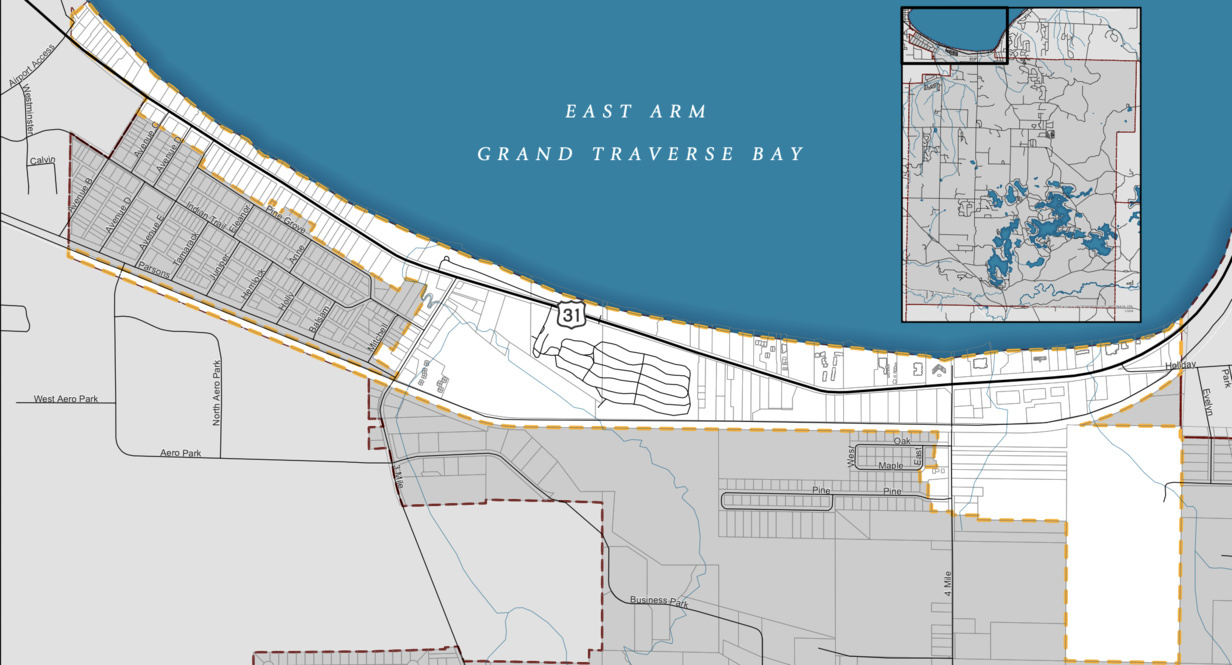
Trustees voted in October to establish a CIA, or a type of TIF district, along US-31 from roughly Avenue B to the eastern township limits (pictured). Like a downtown development authority (DDA), a CIA is a tool in Michigan used to pay for public infrastructure projects. A CIA has a defined time period and a TIF plan describing the projects that would be funded by tax capture. A TIF isn’t a new tax, nor does it raise property taxes; it instead sets a base year for taxable values on properties within the CIA and captures the difference as those values increase over time to fund public improvements.
East Bay Township’s CIA is overseen by a nine-member board appointed by trustees in November that includes Township Supervisor Beth Friend (who is required by law to serve on the board) as well as business and resident representatives from the district area. Chris Cargill, a district neighbor and head brewer at Stone Hound Brewing Company, chairs the board. The board had its first two meetings in December and will meet in 2026 on the third Thursday of every month at 9am at East Bay Township Hall. Meetings are open to the public and televised/streamed through Traverse Area Community Media.
The board’s first major task is to create a TIF/development plan for the CIA district. Township Director of Planning & Zoning Claire Karner explained that the development portion represents “the meat” of the plan, or the list of projects to be funded by TIF dollars. Board members used a survey to rank their priorities among a long list of projects that have been identified by the community to improve the Beach District.
Rising to the top of the TIF list was a Four Mile/US-31 intersection pedestrian crosswalk, US-31 sidewalk network completion, year-round sidewalk maintenance, a community pier at the end of Four Mile on Grand Traverse Bay, and a pedestrian bridge over US-31 to replace the one recently removed at the Traverse City State Park. Medians on US-31, outdoor lighting, and a HAWK pedestrian crossing between Three Mile and Four were also high on the list.
Board members noted that safety was a dominant theme among priority projects, along with placemaking. But members also acknowledged the complexity and cost of many top-ranked projects, such as the pedestrian bridge and pier. CIA Vice Chair Alex Pineau said that several of the lowest-ranked projects – such as a website and business directory, corridor furnishings guidebook, and wayfinding signage – represented “easy low-hanging fruit” that could be tackled to show immediate progress in the district and start a “snowball effect” of momentum for other improvements.
Board members agreed to take another survey that will not only rank projects by priority but also by complexity. Karner said the TIF plan could then use a color-coded system of green/yellow/red to reflect those rankings, with board members looking for “green-green” projects to tackle first that are both a priority for implementation and relatively feasible to accomplish. The board could also simultaneously be working toward bigger projects that will take time to pull off, Karner said.
Applying for major grants is one example of that approach. The CIA board approved a resolution of support to apply for a $150,000 Coastal Management Program grant for the pier, which would cover a feasibility study to identify the best design – including whether it should be a permanent/year-round or seasonal pier – and its engineering. Karner said the board could also look more “holistically” at the site and potential improvements, including a TART Trail connection to the Four Mile neighborhoods, intersection upgrades, a Beach District welcome gateway, bus pullouts, coastline habitat restoration, educational signage, and an accessible kayak launch. The township has also had conversations with Tamarack Lodge about a public-private partnership to build a compact parking deck behind Speedway on a parcel owned by Tamarack, Karner said. Such a partnership could dedicate part of the garage to public parking with easy access to the pier, she noted.
Along with development projects, the draft CIA plan also includes the TIF component or “financing piece” of the puzzle, Karner said. TIF dollars are captured from taxing jurisdictions including Grand Traverse County, East Bay Township, BATA, and Northwestern Michigan College. The CIA district is expected to capture nearly $6.5 million over two decades, starting with just over $33,000 in the first year and gradually increasing to over $652,000 in year 20. That amount is not “enough money to satisfy all of these projects” in the plan, noted Pineau. However, it could provide matching funds for bigger grants, help bond projects over several years, or tackle a series of improvements that make an accumulative impact over two decades.
While many TIF plans go longer than 20 years – 30, 40, or even 50 years is not uncommon, especially if plans are extended – Karner said East Bay Township was trying to be disciplined and “put some guardrails in place so this can be a win-win for the entire community.” She said 20 years was proposed based on the “feedback that we’ve received…(so) that the other taxing jurisdictions are more comfortable with this plan.” That comfort level is crucial, because those taxing jurisdictions – who are pitched on supporting improvements that benefit the community as a whole – can opt out of being included in the TIF plan. Opt-outs could significantly reduce the amount of revenue collected by the CIA district and thus funds available for public projects.
NMC will soon weigh its options on this front; Karner is scheduled to present to the NMC board on January 26. College president Nick Nissley suggested in a November memo that NMC board members wait until they see the draft TIF plan before beginning deliberations, as “we don't know with any certainty or formality the proposed projects, whether they benefit NMC, or how the TIF plan will impact NMC financially.” Karner said township staff will continue meeting with other taxing jurisdictions as well to discuss the proposed plan.
Next steps will include the CIA board adopting a resolution to send the TIF/development plan to trustees for review and approval. The two boards could also hold a joint meeting to review the plan together, Karner said. Prior to its adoption, the township must hold a public hearing on the plan. Taxing jurisdictions have 60 days following that public hearing to exercise their right to opt out. Karner said the goal is to ideally have the new plan adopted by late May.
Comment

Downtown TC to Host "Community Canvas" Art Event
Read More >>Priorities Emerge for East Bay TIF Plan
Read More >>Welcome To The Open Space
Read More >>Where To Ring In 2026 In (Traverse City) Style
Read More >>



What’s Next for Northern Michigan? Leaders Weigh In on 2026
Read More >>Years in The Making: Northern Michigan Names Celebrating Milestone Anniversaries In 2026
Read More >>Shining Bright: East Bay Home A Fixture During Holiday Season
Read More >>From Ski Resort Conditions to Snow-Clearing Updates, Here’s Your Winter Break Report
Read More >>Your 2026 Winter Race Calendar
Read More >>DDA Updates: 2026 Ballot Push for New TIF Plan, Downtown Events
Read More >>