TC Planning Commission Talks Eighth Street Project, Zoning Changes
By Beth Milligan | July 27, 2026
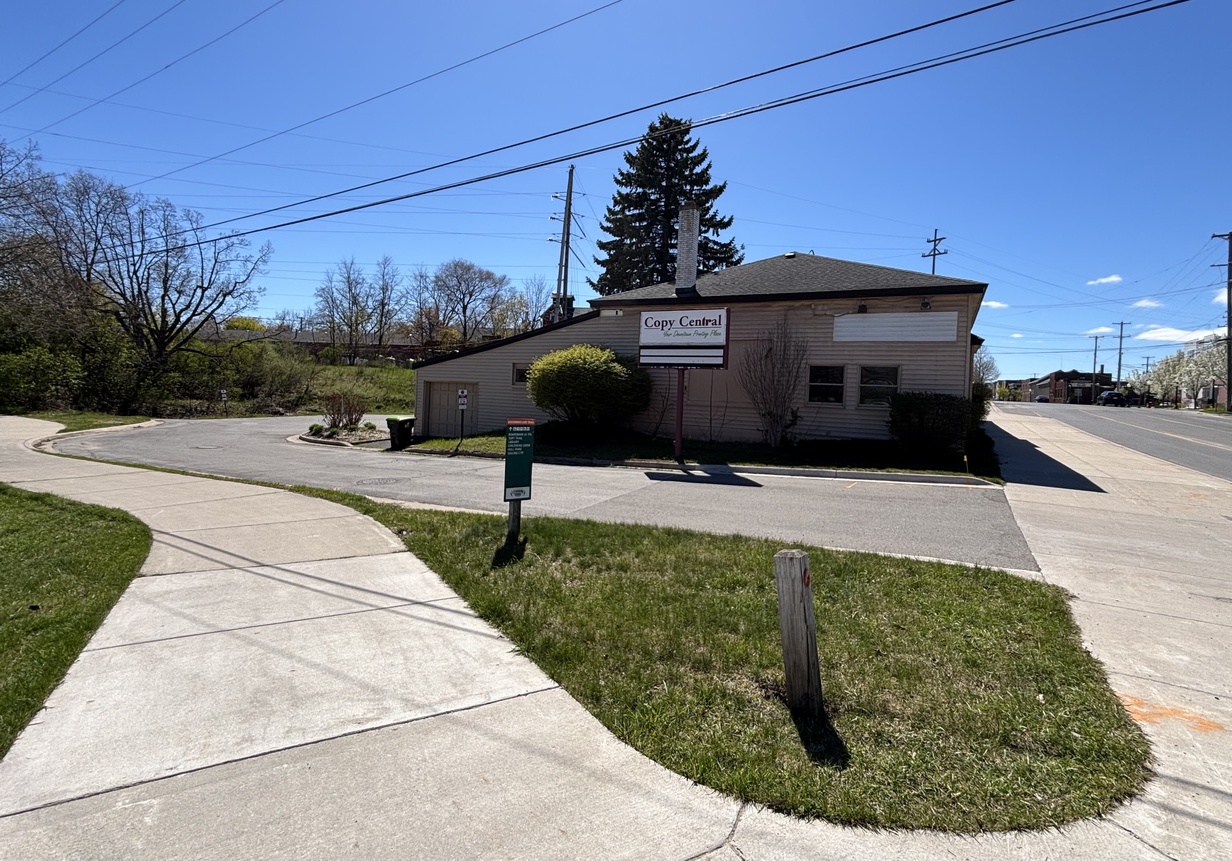
Traverse City planning commissioners will hold a public hearing August 5 on rezoning the former Copy Central site on Eighth Steet, a key step in allowing a workforce housing project to proceed at the site. Planning commissioners are also eyeing zoning changes that could relax rules for accessory dwelling units (ADUs) and childcare centers and establish standards for EV parking.
Eighth Street Housing
Plans by the Traverse City Housing Commission (TCHC) to build a new workforce apartment complex at 314 Eighth Street could soon move forward if the city approves a rezoning request for the property.
Planning commissioners discussed the request at their most recent meeting and agreed to set a public hearing for August 5. The Grand Traverse County Land Bank Authority – which has worked with TCHC, the former Copy Central owners, and the City of Traverse City to assemble multiple parcels for the housing project – has applied to rezone the property from C-2 (Neighborhood Central) to R-3 (Multiple Family Dwelling). Staff said the request is consistent with the city’s master plan, noting that surrounding parcels – some of which are part of the development – are already R-3.
“If this rezoning is approved, it will create an area south of Eighth Street and east of Lake Avenue that is all consistently zoned R-3,” the staff memo states.
One notable aspect of the zoning change is that it would allow for a 45-foot instead of 30-foot building on the site. Currently, a 45-foot building can only be built if it’s commercial, not residential. The extra height would allow TCHC to maximize the apartments built there. Project documents submitted to the county’s Brownfield Redevelopment Authority (BRA) in May show a planned four-story building with 45 units and 47 parking spaces.
City View, as the project is called, received $1.4 million in brownfield funding from the BRA at the May meeting and has also received $656,000 in state grant funding for demolition and clean-up work. TCHC plans to apply for Michigan State Housing Development Authority (MSHDA) funding and a city payment-in-lieu-of-taxes (PILOT) agreement for the housing component.
Aside from the height change, City Deputy Planning Director/Sustainability Coordinator Leslie Sickterman said going from C-2 to R-3 is actually “more restrictive” and a voluntary form of down zoning from the project team, because the property is going from commercial to residential. If planning commissioners approve the rezoning request, it would next go to city commissioners for sign-off.
Zoning Changes
Planning commissioners are eyeing zoning changes that could relax rules for accessory dwelling units (ADUs) and childcare centers and establish standards for EV parking.
Both the city’s strategic action plan and the planning commission’s 2026 goals cite a desire to update ADU standards. Since 2015, 100 ADUs have been approved in the city, according to Sickterman. After changes in recent years to allow more infill housing, 17 second dwelling units have also been approved since 2024. “The impact of these changes has been incremental but significant,” Sickterman wrote.
Planning commissioners discussed possible changes to make it easier to build ADUs, including removing an 800-square-foot size restriction. ADUs could instead be limited to a percentage of the primary dwelling or some other more flexible standard. Multiple planning commissioners said the biggest issue with the current rules is a draconian alley setback requirement, citing a desire to reduce or eliminate that. The board also discussed options to eliminate annual registration, 90-day minimum stay, and owner-occupancy requirements. Short-term rentals are prohibited in residential districts, so those changes could make it easier to build and operate ADUs as long-term rentals while still maintaining a vacation rental ban.
City commissioners also discussed ADUs this month on the heels of approving a new incentive program that offers property owners tax exemptions in exchange for renting units to income-qualified tenants. Commissioners asked the planning commission to send them recommendations on proposed ADU changes by the end of the year, including possible “pattern book” options. Those would be a set of ADU design plans that could fit a variety of common lot sizes that are preapproved by the city and county construction code, saving homeowners significant time and expense in building ADUs.
Addressing childcare is another issue highlighted in the city’s strategic action plan. Planning commissioners discussed several changes the city could enact to make it easier to operate childcare centers. Those included making child care organizations, family child care homes, and group child care homes a use by right in every zoning district and removing most of the standards for group child care homes.
Sickterman pointed out that such facilities must still go through “rigorous licensing requirements imposed by the state,” so additional city burdens – like parking, operating hours, and playground restrictions – pile on unnecessary barriers for providers. The city could also remove the requirement that child care organizations be associated with a school or place of worship in residential and commercial districts. “This use is consistent with a residential neighborhood whether or not it is co-located within a church or school,” Sickterman said.
Finally, planning commissioners are considering implementing standards for electric vehicle (EV) charging stations. Having such standards for new construction projects is “an increasingly common approach among cities in Michigan,” Sickterman wrote. Changes could allow EV parking to count towards minimum parking requirements and categorize EV charging equipment as an allowed use by right in all commercial and industrial zoning districts. The city’s minimum parking requirements for various districts could also be updated to include a minimum percentage of EV spaces.
Planning commissioners could begin moving forward all of the zoning changes above in a series of public hearings this fall, with any zoning amendments then going to city commissioners for final approval.
Comment

TC Planning Commission Talks Eighth Street Project, Zoning Changes
Read More >>Dems Square Off In 37th Senate District Primary
Read More >>Community Group Aims To Raise Thousands For Central Grade HVAC
Read More >>Flapjack & Flannel Festival Off for 2026, Will Return in 2027
Read More >>



Garfield Township Tees Up Data Center Moratorium; Incomplete Application Submitted for Project
Read More >>Two Proposals Emerge for City West End Property
Read More >>Peninsula Homeowners vs. Consumers Energy: Long-Running Dispute Heads To MPSC Hearing
Read More >>City Commissioners Approve Two-Way Streets, TIF Ballot Language
Read More >>The 2026 Cherry Crop Report
Read More >>OOPs 2.0: NMC Reimagines Its Innovation & Entrepreneurship Office
Read More >>