
Women's Resource Center Launches $3 Million Capital Campaign To Expand Transitional Housing Offerings
By Craig Manning | Dec. 14, 2025
The Women’s Resource Center (WRC) is launching a $3 million capital campaign to expand and reimagine its transitional home for women fleeing abusive households. Since 1999, the nonprofit has relied on the transitional house as a bridge to get domestic violence survivors out of emergency shelters and moving toward a fresh start. The $3 million campaign, which Executive Director Juliette Schultz says is the biggest fundraiser the WRC has undertaken since she stepped into the leadership role in 2013, will expand the organization’s transitional housing offerings by 25 percent.
The core component of WRC is its emergency shelter, which has a 22-person capacity and “is almost always full,” according to Schultz. She says transitional housing is an important part of the continuum of care because it keeps women moving through the system and frees up space at the shelter.
“There's a lot of demand for emergency shelter for people who are fleeing a violent home, so if survivors have a safe, affordable housing option they can go to once they leave emergency shelter, then that obviously makes space for another survivor to come into the shelter,” Schultz tells The Ticker.
“Since 1999, our transitional house has served as a bridge toward more permanent housing for over 260 survivors,” Schultz says. “When somebody is leaving our emergency shelter, oftentimes there is not another housing option available to them. So, women can move from the emergency shelter into this house, where they can live for up to two years. And the coolest part, I think, is that they pay rent based on their income. So, if they can only afford to pay $1 a month, that’s what they pay. $400 a month is the maximum amount anyone would pay.”
According to Schultz, the two-year timeline is usually just the right amount of runway to give survivors the reset they need – emotionally and economically.
“What we see is that, by the time a person moves out of the transitional house, typically they are employed, they are a little more financially stable, and they’ve now established some credit history,” she says. “We just had somebody move out, and she got her own apartment and was able to furnish that apartment by shopping the WRC thrift shop.”
Despite its utility for the WRC system, the transitional house has a few shortcomings. It's only 16 beds, and the house has a “community living” layout, with four separate bedrooms and shared kitchen, bathroom, and living room spaces. Privacy, in other words, is hard to come by.
When WRC conducted a “fundraising feasibility study” two years ago, reimagining the transitional house was flagged as the top-priority project.
“We asked the public about two specific projects that we were thinking about raising money for that directly corresponded with our mission,” Schultz says of the study. “We got more than 70 responses – and some of those were from survivors of domestic violence – and the respondents chose this renovation and expansion of our transitional house as the project we should focus our attention on.”
The project will cost $3 million and will convert the house into “a more private environment for families,” with 10 separate apartments rather than the communal living setup. The plan calls for six studio apartments, a pair of two-bedroom apartments, and two three-bedroom apartments – increasing the capacity from 12 beds to 16.
“We had to build out our internal infrastructure so we could support a capital campaign,” Schultz says, explaining why it took two years after the feasibility study for WRC to start raising money. “In the time that I've been here at the WRC, we have not really had a true capital campaign, at least not of this size and scope. We started by building our team and getting our processes tightened up and in place, so that we would be prepared to talk with the community about the project and then also offer them different ways to support it.”
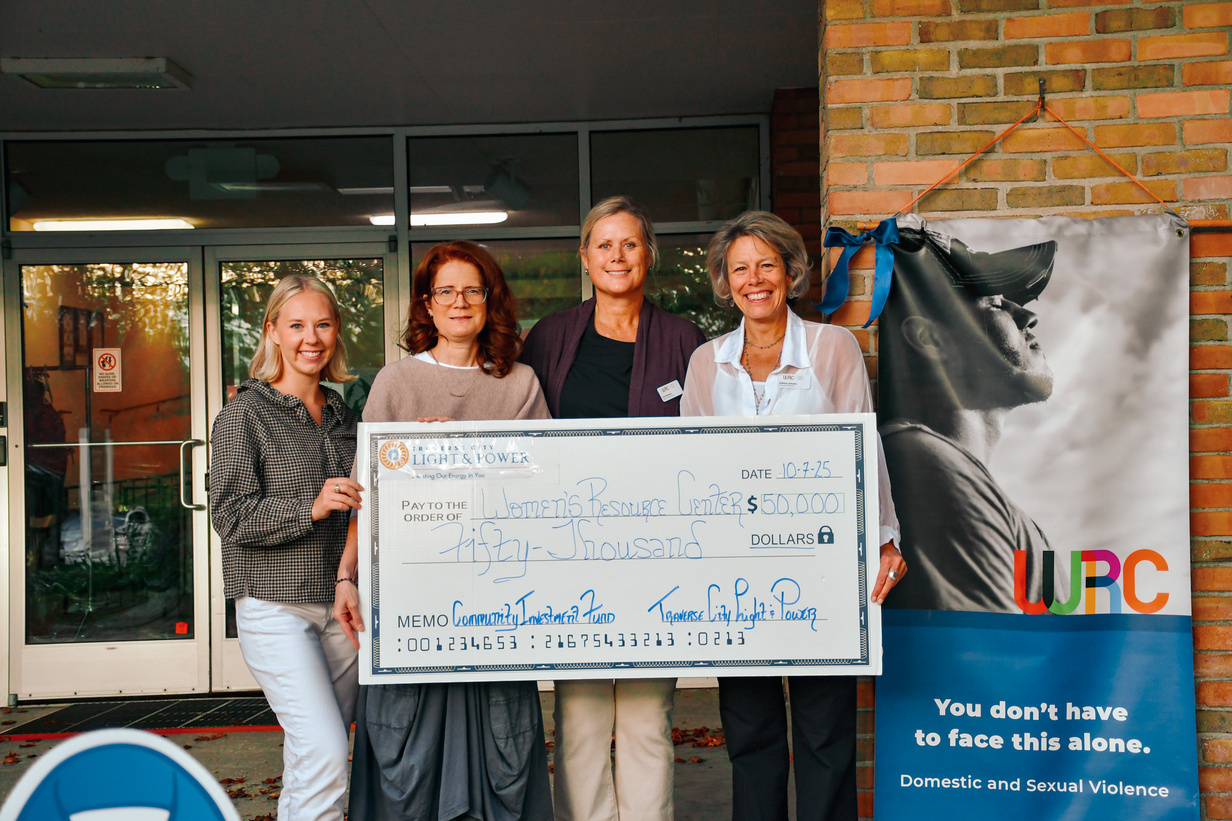
WRC is technically in the “quiet phase” of the campaign, dubbed Home SAFE Home, “where we’re just quietly doing outreach to friends of the WRC” to build a base of funds, Schultz says. But that phase has been lucrative, with the nonprofit raising more than $400,000 in just the first few months, including a $50,000 grant from Traverse City Light & Power's Community Investment Fund (pictured). The WRC aims to hit its goal next year and complete the renovation by 2027.
CORRECTION: A previous version of this article state that children or moms from multiple different families might end up sharing rooms at WRC's transitional house due to the communal living design. Schultz has clarified that this type of living situation is "true at our emergency shelter, [but] not true at the transitional home. Families at the transitional home share bedrooms (if necessary) but people are not sharing rooms with non-family members."
Comment

Avelo Airlines Suspends Cherry Capital Airport Service – For Now
Read More >>From Protest Walkouts to Turning Point Launch, Students Get Engaged Politically
Read More >>GTB Announces Latest Round Of 2% Grants
Read More >>Kingsley Contractor Charged with Fraud
Read More >>



Hurshe Out at Munson Medical Center
Read More >>Folded Leaf Coming to Commongrounds, “Clean” Café Opening on Front Steet; More Restaurant/Retail News
Read More >>Farmhouse Fire Shuts Down Hammond Road
Read More >>The 2026 Bayshore Marathon Will Be An Olympic Trials Qualifying Event
Read More >>TCFD Makes Progress Toward Ambulance Expansion, But Staffing Remains Challenge
Read More >>NMC Finalizes Boardman Lake Campus Sale
Read More >>