
City Eyes Major Boardman/Washington/Cass/State Project
By Beth Milligan | Oct. 20, 2026
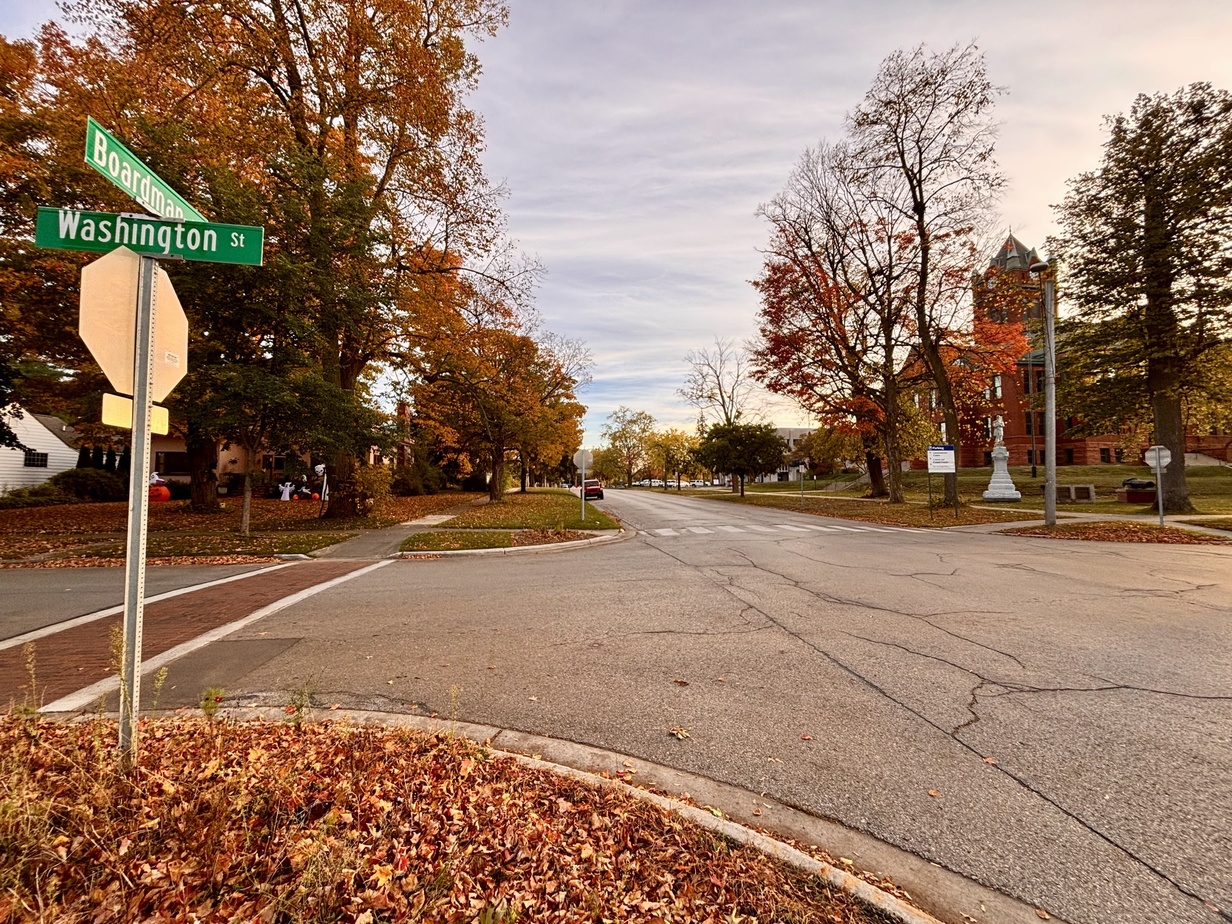
The City of Traverse City is gearing up for a major construction project in 2028 and 2029 that will replace water and sewer mains under Boardman Avenue, Washington Street, Cass Street, and State Street – plus reconstruct the streets and add new cycling and pedestrian amenities. The city will hold a public open house today (Tuesday) from 4pm to 6pm at the Governmental Center to explain the estimated $5 million-plus project and gather feedback.
A brownfield plan for the area around the Park Place Hotel identifies more than $1 million in available funding for infrastructure improvements. The project area includes Boardman Avenue from Eighth Street to Front Street, Washington Street from Boardman to Cass, Cass from Washington to State, about half of the public alley between Cass and Union near Central United Methodist Church, and State Street from Boardman halfway to Park Street.
The city completed a water reliability study in 2021 that calls for upsizing water mains as one of its “higher priorities,” says City Engineer Anne Pagano. Existing 6-inch water mains will be replaced with 12-inch mains, more than doubling their capacity, according to City Director of Municipal Utilities Art Krueger. Since the lines connect to bigger transmission lines on Eighth and Front, the upsized connections will offer “looping and fire flow benefits throughout this whole area,” he says.
Hundreds of feet of sanitary sewer lines will also be replaced. Those lines are old clay pipe – some dating back to the 1940s – which the city tries to replace anytime it’s already ripping up pavement, Krueger says. Contractors typically leave the old lines in place while installing the new ones to avoid disruptions.
Several streets were already eyed for reconstruction; those can now be coordinated with the underground utility work “to provide a cost savings because you’re not tearing up the street twice,” explains Pagano. The city rates the condition of every street on a scale of 1 to 10 with a system called a PASER rating, with 1 being total failure and 10 being brand new road. Boardman Avenue and Washington Street are both rated a 2; Cass Street between Washington and State streets is a 3.
The city adopted a complete streets policy in December that prioritizes “bicycling, walking, rolling, micro-mobility, and public transit” as part of street design. It requires complete street principles to be applied to all road construction projects and for safe access or detour routes to be provided for all transport modes during construction.
The city’s Mobility Action Plan identifies Boardman, State, and Cass as part of a future citywide bike network. Accordingly, staff are looking at options to improve walking, biking, transit access, and accessibility as part of the project. “While replacing aging utilities is a key component of the project, reconstruction provides an opportunity to consider how people move through and experience these streets,” the city posted online.
The bike network vision “doesn’t necessarily mean a bike lane” on every street, explains Pagano. “It could be a sharrow (a shared vehicle/bike lane), a separated bike lane, or other treatments to be determined. Those are the kinds of things we’re looking for feedback from the community and cyclists on that would help inform the design.”
While State Street is only a small section of the project area, it has some unique design considerations. Commissioners voted in July to make the two-way traffic flow on State, Pine, and Boardman permanent. City and TC Downtown Development Authority (DDA) staff are now working with consultants on improvements to enhance the two-way flow, including signal upgrades and mid-block pedestrian crossings.
Much of the two-way conversion work falls outside the water main project, but the design of one section of State Street could shape the rest. Bike lanes are a key example. State currently has only an eastbound bike lane, reflecting its previous one-way traffic pattern. Adding a westbound lane is possible but could mean sacrificing parking, Pagano says. The city’s Complete Streets Advisory Committee will review two-way improvement options in November. While separate from the utility and street reconstruction project, both efforts will be “explored in tandem” to ensure they align, Pagano says.
City commissioners in June approved a not-to-exceed $206,839 contract with AECOM for preliminary design work on the utility and street reconstruction project, plus a second not-to-exceed contract for $30,879.73 with Soils & Structures for geotechnical engineering. In addition to today’s open house, the city plans to use a community survey to get input. From there, AECOM will finalize a preliminary design in the coming months, with more opportunity for feedback at a second open house and commission study session. The Complete Streets Advisory Committee will also have a review role.
The actual construction work is tentatively slated to occur in two phases across the summers of 2028 and 2029. “Looking at the locations, being downtown, we don’t think it can be done all at once,” says Pagano. That’s because the potential disruption impact is significant: Work is not only occurring along main downtown corridors during the busy season, but access must be maintained to key locations like the Governmental Center, the courthouses, and the county jail. The exact timing of work and planned detour routes will be finalized as plans progress.
The final price tag is also to be determined. Preliminary estimates put the project at more than $5 million. In addition to the $1 million available in brownfield funding, “we’ll definitely be pulling from different funds” for the rest, Pagano says, which could include the city’s water, sewer, and street funds.
Comment

City Eyes Major Boardman/Washington/Cass/State Project
Read More >>Annual TC Patriot Game Set for Friday at Thirlby Field
Read More >>NMC Lands $630,000 Grant from the State
Read More >>Prowling Ordinance, Attainable Housing District Headed to Commission Vote
Read More >>



Local Clerks Debunk Voting Misinformation
Read More >>Candidates Square Off In 103rd State House Race
Read More >>Traverse City Central's New 'Ride Lab' Uses Skateboards to Teach Physics, Business Skills
Read More >>Garfield Township Approves South Airport Sewer Work, Townline Rezoning, Trail Projects
Read More >>TC Man Faces Felony Charge for Threatening to Kill Prosecutor
Read More >>County to Consider North Sky Lease; Funding Allocations to Support County Services
Read More >>