Great Lakes Maritime Leaders Grapple With Federal Waivers, Nationwide 'Uncertainty'
By Craig Manning | Aug. 9, 2026
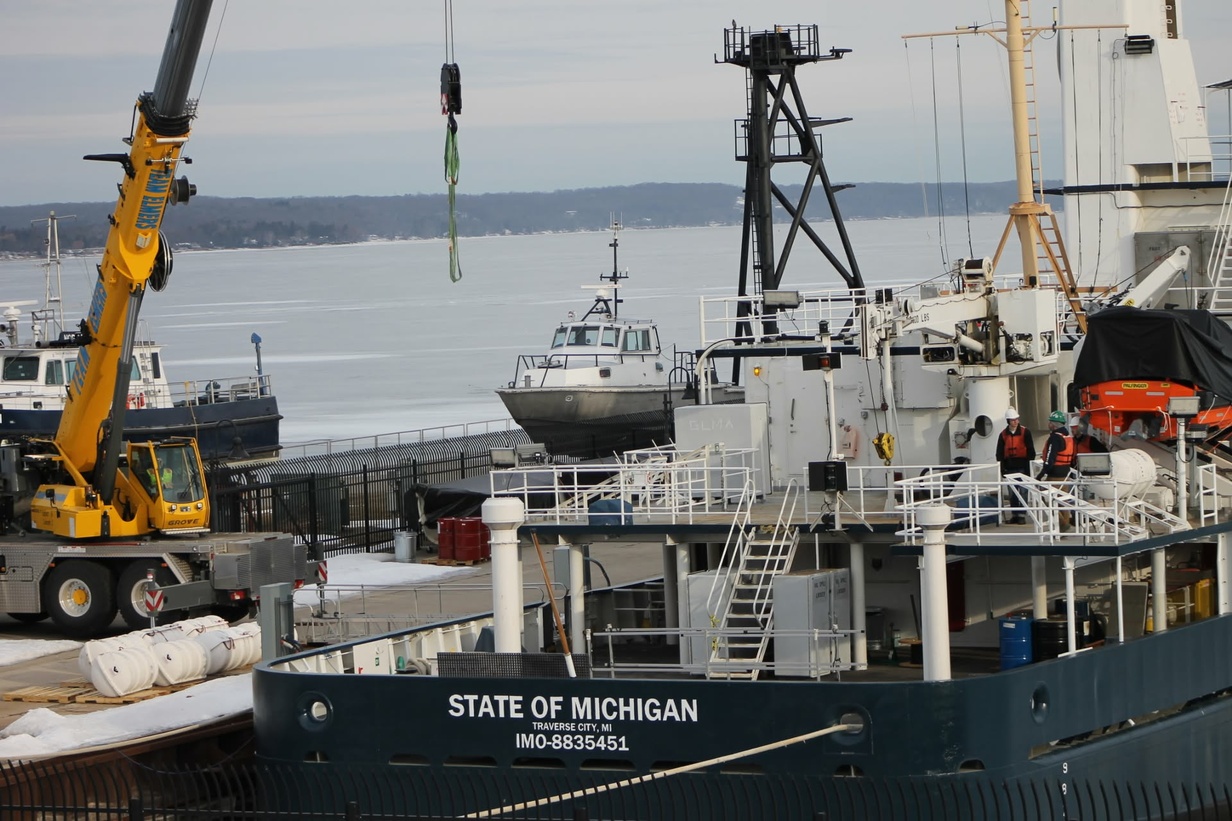
An ongoing series of federal waivers has created a storm of uncertainty for the United States maritime industry, with experts foreseeing potentially devastating implications for the Great Lakes shipping and Traverse City’s own Great Lakes Maritime Academy (GLMA). The waivers suspend a century-old federal law called the Jones Act, which requires cargo shipped between domestic ports to be transported on vessels built in America, owned and operated by American companies, and predominantly crewed by American workers.
Adopted as part of the Merchant Marine Act of 1920, the Jones Act has been the subject of fierce debate for years. Defenders say the law is vital for supply chains, American maritime supremacy, and even national security. Critics call it “protectionist,” claiming it gives U.S. shipyards and carriers a monopoly on domestic shipping and leads to higher shipbuilding costs, domestic shipping rates, and end-consumer prices. Last year, U.S. Senator Mike Lee (R-Utah) and U.S. Representative Tom McClintock (R-California), even introduced legislation aimed at repealing the Jones Act entirely.
While it would take an act of Congress to end the Jones Act, the president does have power to issue temporary waivers, and the regulation has been waived several times over the decades in response to wars or natural disasters. On March 17, President Donald Trump issued a 60-day waiver, ostensibly to ease surging gas prices in the midst of America’s undeclared war with Iran and the resulting closure of Iran’s Strait of Hormuz. In late April, the Department of Homeland Security approved a 90-day extension, to begin on May 18. That extension expires next Sunday, August 16, but a report from Reuters this week indicated the White House is planning to extend the Jones Act waiver further.
Even without another extension, this waiver period will go down as the lengthiest in Jones Act history. According to the Cato Institute, which maintains a tracker “documenting domestic cargo movements” under the waiver, 170 foreign ships have completed 210 domestic shipping voyages since March 17.
Jim Weakley, president of the Lake Carriers’ Association (LCA), says the Great Lakes have so far been insulated from the effects of the waivers. The LCA represents “U.S.-flag lakers operating exclusively on the Great Lakes, moving solid bulk products” – a fleet which collectively transports 90 million tons of iron ore, limestone, coal, cement, salt, sand, and grain annually
“There have been a couple of fuel cargos that moved from Toledo to Green Bay [under the waiver] – and by ‘fuel,’ we're talking gasoline,” Weakley says. “I don't represent the Great Lakes companies that would have been able to move that cargo, so [the waivers] have not really had an impact on my numbers yet. The good news is, for solid bulk, most of our carriers have longer-term contracts.”
But while direct impacts on Great Lakes shipping have thus far been minimal, Weakley says he and his constituents are still feeling the effects of Jones Act waivers “because of the uncertainty” they have caused industry-wide.
“We’re clearly seeing, on the coasts, tank barges and tank ships being displaced by foreign operators,” Weakley says. “That has the short-term impact of those people losing their jobs and those profits going overseas. But there are mid-term impacts, too, because a lot of those tankers are due to be replaced in the next couple years, and the banks aren't giving loans and the companies aren't investing given this level of uncertainty. There are literally billions of dollars sitting on the sideline because of this waiver.”
According to GLMA Superintendent Jerry Achenbach, the situation is starting to hit close to home here in Traverse CIty. While some GLMA grads do take jobs on Great Lakes ships, many others head to the coasts for work, “and those jobs are disappearing as vessels are laid up.”
For now, Achenbach says maritime retains its reputation as a high-paying career, noting that 2026 GLMA graduates finished school with a “reasonable expectation” of earning $130,000 per year for six months at sea. The academy takes 60 cadets a year, and consistently draws “several hundred applications” for those seats.
“Other academies are also possibly at record enrollment,” Achenbach adds. “2015, I believe, was the high-water mark for number of cadets at the seven U.S. maritime academies, and we may be higher than that in 2026.”
But Weakley believes the numbers are only strong because students applying to maritime academies are “making that decision based on historical information,” not future outlook.
“If the Jones Act goes away, or if this uncertainty continues, it would make me think twice about entering the industry,” Weakley says. “Jobs on the coasts are going to dry up quicker than they are here, and then all those coastal union members with seniority are going to come to the Great Lakes, and it'll be harder to get a job at the entry level. I fear it could be a return to the 1980s, when graduates were not able to find jobs in our industry.”
Weakley believes Jones Act opponents “smell blood in the water” and will use this moment to push forward a total repeal of the law. In particular, he points the finger at the oil companies, which he says are enjoying a profit margin “three times what it was last year at this time” thanks in part to the waivers. And while maritime workers would be the hardest hit by a full repeal of the Jones Act, Weakley insists the average consumer should care about the possibility, too.
“The biggest reason is supply chain integrity,” Weakley says. “Our American industrial base is made possible by efficient transportation. On the Great Lakes, we make steel possible, and without our ability to move heavy materials efficiently, you wouldn't have any steel manufacturing in the U.S. We also make construction zone and aggregate affordable by our ability to move it on the Great Lakes. And once you lose the ability to control that supply chain, you've given away your economic as well as your military strength.”
Comment

Great Lakes Maritime Leaders Grapple With Federal Waivers, Nationwide 'Uncertainty'
Read More >>(Over)Supply And Demand? Local Rental Storage Market Sags
Read More >>Shorts to Host First Event at "Short's Landing" on Aug. 15
Read More >>What's Next For Interlochen Abuse Investigations?
Read More >>



Mall Businesses on the Move, Mill District Plans Take Shape, More Retail/Restaurant News
Read More >>2026 Primary Election Results
Read More >>Munson Commits $100,000 to Grand Traverse Area Women’s Resource Center
Read More >>Tom Stokes, Pioneering Traverse City Music Educator, Has Passed Away
Read More >>City Manager Issues Statement on Planning Director Firing
Read More >>East Bay Projects on Deck: New Development, Safe Routes to School, TART
Read More >>