
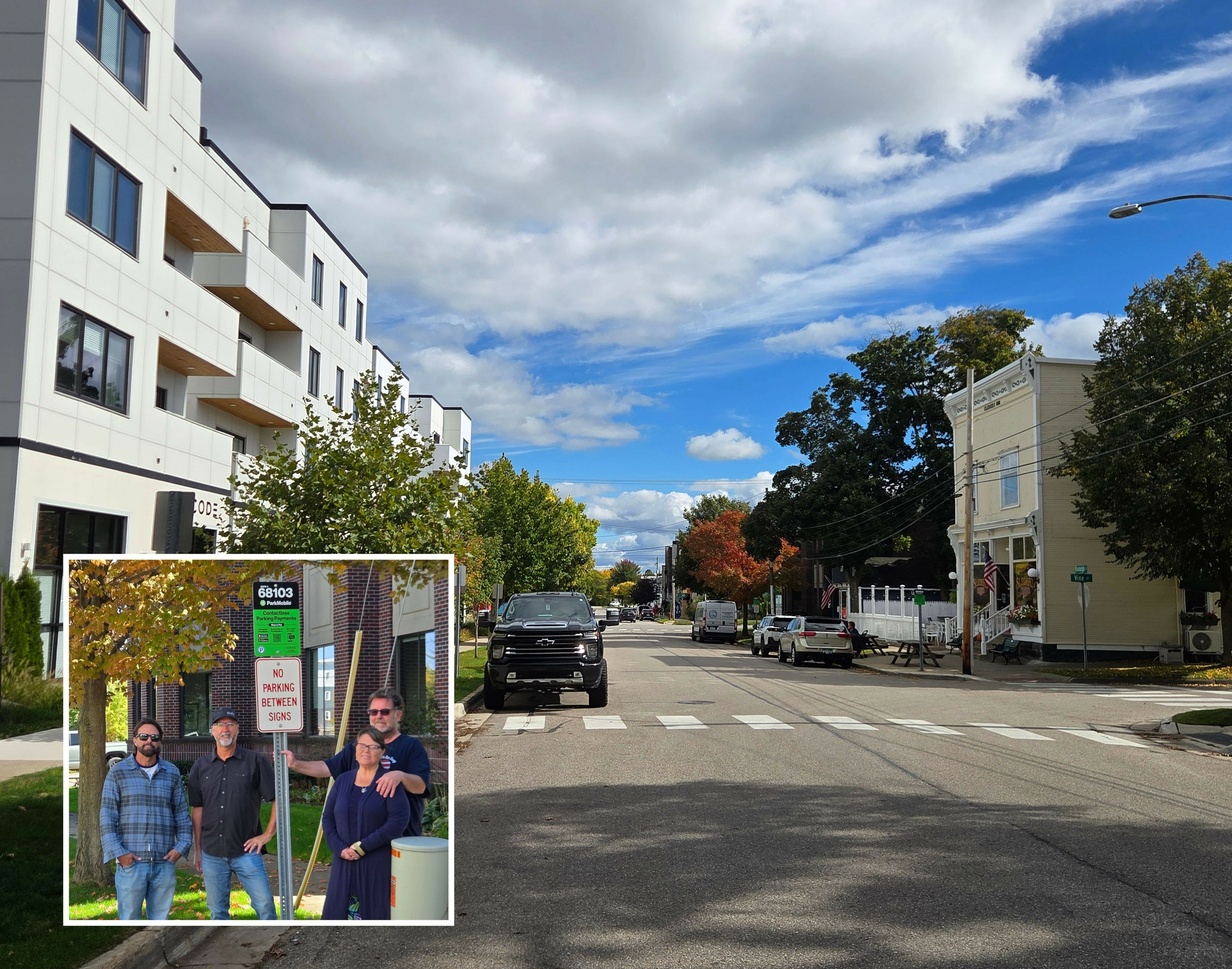
'I'm Going To Lose Business:' Shop Owners Irate Over Randolph Street Paid Parking
By Art Bukowski | Oct. 3, 2026
Business owners along Randolph Street west of Division are furious about the city’s recent implementation of paid parking there.
Owners and managers of The Dairy Lodge, Slabtown Barber Shop, Sleder’s Family Tavern and several other longtime or newer businesses are upset they weren’t consulted about the change, critical of the format (visitors must pay by app or phone since there are no meters or pay stations) and/or worried the new setup will frustrate or deter customers.
The city says paid parking is primarily intended to address congestion in the corridor and will be reevaluated after a 90-day trial period.
About a month back, little green pay-to-park signs appeared along what was once free, on-street parking (though there was a two-hour limit) on Randolph from Division west to Cedar Street. The signs instruct parkers to pay via the ParkMobile app, or to pay by text or phone.
That was strike one for Matt Dohm, who owns Slabtown Barber Shop. Using an app or phone to pay isn’t ideal for many of his customers.
“I had two guys in here a week ago that had flip phones. They sure don’t have ParkMobile,” he tells The Ticker. “A couple of our guys literally don’t even have credit cards. They’re 90 years old.”
Dohm has been getting complaints every day (he even made business cards with city parking director Nicole VanNess’ contact info to hand to disgruntled customers) and he’s worried the situation is going to lead to customers looking for haircuts elsewhere.
“I’m going to lose business because this impacts convenience,” he says. “I’m going to lose guys who are going to go to Meijer or something because they can park for free, or not have this hassle with the app and worry about paying $15 or $20 for a ticket.”
Laura Millar, owner of Artful Interiors across the street in the new-ish large building there, very much shares those concerns. She decided to open her business along Randolph instead of downtown in large part due to free street parking, and she’s worried now that people who are curious about her shop will be deterred from stopping in.
“This is already hurting my business. I am beside myself,” she tells The Ticker. “If I had been here for 30 years, I’d have a following, but I am still building this business...and I count on spontaneous customers.”
Dairy Lodge owner Stacey Popp and her fiancé Ron “Blue” Moeggenberg are – like the rest of these business owners – upset that they weren’t consulted before the paid parking was installed.
“This affects us. They should have had a meeting with the business owners. They’re regulating our businesses right now with this parking,” Moeggenberg tells The Ticker. “Whatever happened to being neighborly?”
Chad Smartsy, who owns the Hair Code Salon (next to Artful Interiors), says the whole thing just seems like a cash grab by the city in an area that is increasingly popular.
“The two-hour thing was working fine, but it wasn’t working for them because they weren’t making enough money,” he tells The Ticker.
The team at Sleder’s, self-billed as Michigan’s oldest continually operating restaurant, is irked for a different reason. They have their own lot just west of the restaurant, but they worry it’s now going to fill with customers of neighboring businesses. That’s a problem in more ways than one, as it's less space for their customers to park and a potential deterrent for customers who see a full lot and assume long wait times.
“There's been so many times people have come in here and they're like, 'Oh, I though you were going to be so busy because your parking lot is full,' but we’re actually dead,” front-of-house manger Alicia Mason tells The Ticker.
VanNess tells The Ticker that the city installed paid parking on Randolph after repeated complaints about traffic congestion there, in part due to the narrowing effect of on-street parking. Instead of removing on-street parking on one or both sides, the decision was made to trial paid parking for 90 days.
Paid parking is likely to force vehicle turnover and prevent cars from sitting in a spot for a long time, VanNess says, potentially reducing the number of vehicles that serve to narrow the road. Incidentally, this turnover could benefit businesses by increasing available parking for customers, she says.
Regarding a lack of meters or a pay station, VanNess says it doesn’t make sense to put them there before any final decision is made regarding paid parking. Feedback gathered during the 90-day trial period will inform that decision.
“Using the existing mobile payment system allows the city to test the approach without installing permanent infrastructure,” she says.
VanNess acknowledges that business owners weren’t consulted, but says the city has an obligation to address the congestion there.
“The city has a responsibility to evaluate and respond to traffic and public safety concerns when they are identified,” she says. “Property owners were provided advance notice before the parking changes were implemented.”
Finally, she rejects the notion that this was done to generate revenue.
“In fact, the parking rates were intentionally set below the city’s standard rates, and the revenue generated during the pilot is expected to be minimal and may not cover basic implementation costs,” she says.
Inset, L-R: Smartsy, Dohm, Popp and Moeggenberg
Comment

'I'm Going To Lose Business:' Shop Owners Irate Over Randolph Street Paid Parking
Read More >>Man Arrested After Stealing Front-Loader From Construction Site
Read More >>Munson Rolls Out New Medicaid Support Initiative
Read More >>NMC Resurrects Competitive Flight Team After Decades of Dormancy
Read More >>



Norte to Host Ribbon Cutting, Open House for Pump Track
Read More >>Former Planning Director Files Whistleblower Lawsuit Against City
Read More >>Kingsley Area Schools Responds to Threat
Read More >>Does City Have Fair Representation on Airport Board?
Read More >>Beyond Juicery, New Boutiques Opening in TC; More Restaurant, Retail News
Read More >>Airport Board Meetings Ready For Public Viewing
Read More >>