
Street & Infrastructure Projects Top City Agenda
By Beth Milligan | Dec. 8, 2025
Traverse City commissioners will discuss several upcoming 2026 projects at their 7pm study session tonight (Monday) – including the reconstruction of Monroe Street, a Cass Street mid-block crossing, storm sewer replacement at Ramsdell Pond, and membrane replacement at the city’s wastewater treatment plant. Commissioners will also discuss a proposed complete streets policy for the city.
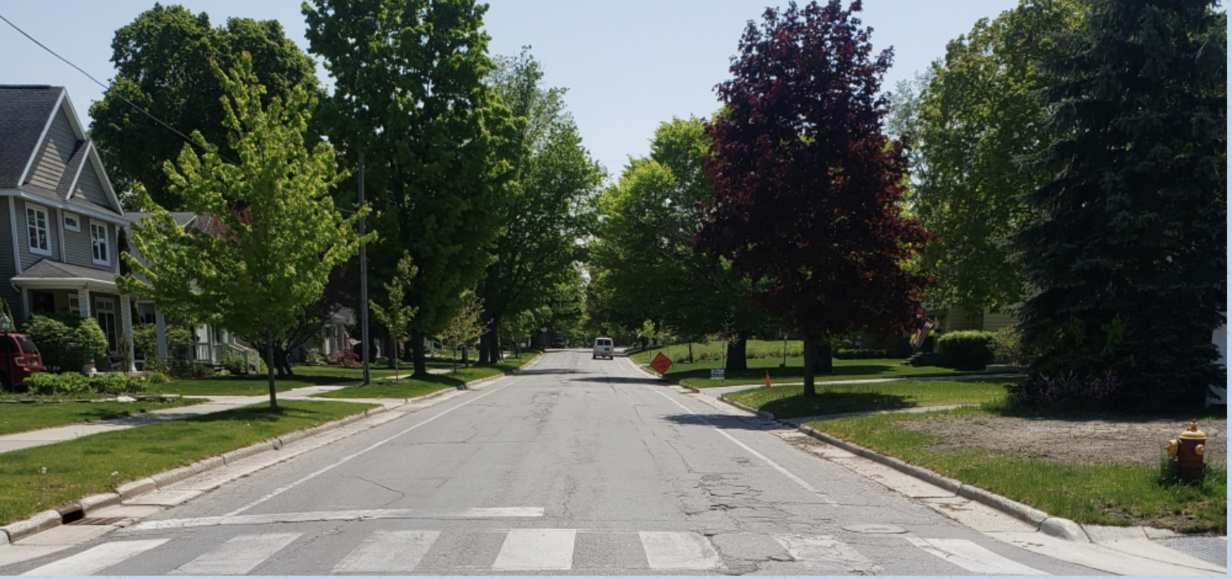
The city is planning to rebuild Monroe Street (pictured) from Front Street to Bay Street in 2026, with the city’s website listing a planned April-November construction timeline. According to City Engineer Anne Pagano, on a scale of 1 (worst) to 10 (best) on the city’s Pavement Surface Evaluation and Rating (PASER) scale, Monroe Street is a 2. Because of its poor condition and the need for upgraded utilities, Monroe has “been a high priority” on the city’s reconstruction list for several years, Pagano says.
In addition to the complete reconstruction of the street – which will introduce bump-outs at every intersection and parking on both sides of the street – water and sanitary sewer improvements and green infrastructure like bioswales and drywells are planned. While 13 trees are planned to be removed, 20 replacements will be planted in 2027, according to project drawings. Topsoil restoration, new culvert near Randolph Street, and new sidewalk between Wayne and Hill streets are also described in the plans.
The project has an estimated cost of $4 million, with funds coming from a combination of the city’s street, sewer, and water funds. Staff plan to put the project out for bid in the next few weeks and bundle it with two smaller projects to provide economies of scale and cost savings, according to Pagano. Those projects include replacing the mid-block crosswalk in the 100 block of Cass Street and repairing Ramsdell Pond’s storm sewer system.
Commissioners in August blocked the Traverse City Downtown Development Authority (DDA) from using $98,000 in TIF 97 funds to repair the Cass Street crosswalk. Some on the board, such as former Commissioner Tim Werner, said they wanted to see the crosswalk redesigned with bump-outs that would narrow the crossing and increase the visibility of pedestrians. However, that change increased the scope of the project, bumping it off the 2025 repair list and requiring the city to cover the cost difference. A memo from Pagano shows the redesigned Cass crossing will now cost roughly $365,000, with the city’s water and street funds to help cover costs along with TIF 97.
The Ramsdell Pond repairs are estimated at $60,000 and will be covered by the city’s stormwater maintenance fund. According to Pagano, “this proposed project is a maintenance-related repair to install a new manhole and replace about 235 feet of clay and corrugated metal piping (CMP) including elbows and vertical deflections.” Pagano says the replacement is needed “due to ongoing maintenance of root intrusion and line congestion.”
Commissioners tonight will also hear a presentation from Jacobs, the firm that operates the city’s wastewater treatment plant. The company will outline a plan for replacing membrane trains – essential filtration equipment – in the coming years at the plant. Membrane options on the market now allow for lower energy usage and longer lifespans, potentially up to 15-20 years. As the city has done in the past, it will consider an approach that replaces membranes on a one-per-year schedule through 2033. First-year costs for 2026 are estimated between $1.57 and $1.87 million – some tank upgrades and other upfront work are required in year one – with a second membrane replaced in 2027 at a projected cost of $1-$1.3 million.
Also related to infrastructure, commissioners will discuss the city’s proposed new complete streets policy tonight. The policy, which has been in the works since 2022, aims to “set clear, measurable goals so that progress may be fairly evaluated” as the city strives to create an “complete and connected transportation system that enhances safety, health, and quality of life,” according to the latest draft.
The policy “prioritizes sustainable transportation modes such as bicycling, walking, rolling, micro-mobility, and public transit,” according to the draft. “Additionally, it supports climate mitigation efforts by reducing greenhouse gas emissions through increased use of non-motorized and public transportation.” While the policy will apply citywide, it prioritizes complete streets improvements in “historically underinvested and underserved neighborhoods.”
The policy requires complete street principles to be applied to all city transportation projects, including “new construction, reconstruction, resurfacing, repaving, restriping, and rehabilitation.” One percent of the city’s annual budget will be dedicated to complete streets projects. Exceptions to the policy would only be granted when improvements don’t meet minimum safety standards, or when “data indicates that establishing new facilities such as bikeways or walkways are excessively costly in relation to the cost of the larger project adjacent to the planned improvements,” the draft states. Such exceptions would require the approval of commissioners, with documentation supporting the exception made available to the public at least 30 days before it’s approved.
Because commissioners are in study session tonight, they will only discuss – not vote on – the above agenda items. Items will be updated with commission feedback and return for approval at a future meeting.
Photo credit: City of TC
Comment

Farmhouse Fire Shuts Down Hammond Road
Read More >>The 2026 Bayshore Marathon Will Be An Olympic Trials Qualifying Event
Read More >>Global Brand, Local Focus: Inside Interlochen's New Northern Michigan Opportunity Scholarship
Read More >>Eater Names Traverse City Among 15 Top Food Destinations in 2026
Read More >>



Greenspire Addresses Future at Boardman Lake Campus
Read More >>TCFD Makes Progress Toward Ambulance Expansion, But Staffing Remains Challenge
Read More >>NMC Finalizes Boardman Lake Campus Sale
Read More >>Road Commission Eyes Partnerships for Zimmerman Extension, More Road Projects
Read More >>Traverse City Wineries Score National Awards
Read More >>The Summer Camp Shuffle: Your Guide To 2026 Sign-Up Season
Read More >>