
West End Parking, Housing Incentives, Fund Balance & More on City Agenda
By Beth Milligan | Feb. 17, 2026
In addition to voting on a permanent two-way State Street tonight (Tuesday), Traverse City commissioners will tackle a busy agenda that includes seeking possible proposals for a west end development, approving affordable housing incentives, suspending the city’s fund balance policy, and more.
West End Parking
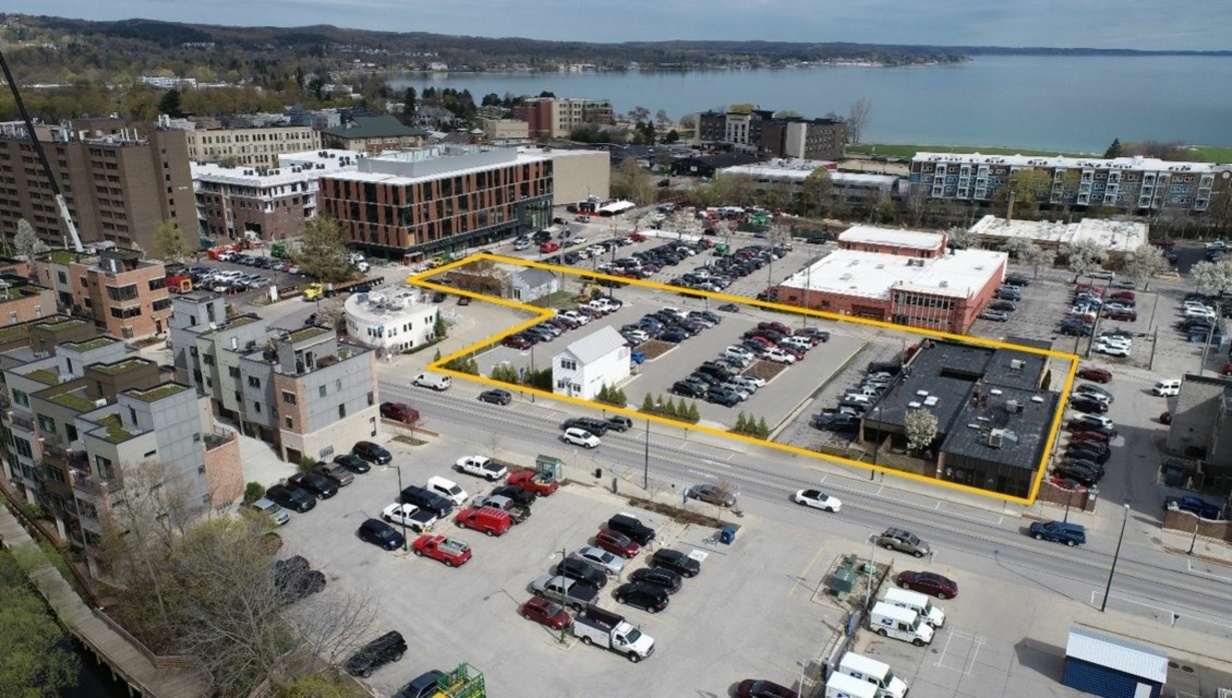
Following a recent proposal by developer John Socks to partner with the city to build a public-private parking deck on State Street, commissioners tonight will discuss a recommended process to solicit a variety of proposals for city-owned properties in the corridor.
Consultant Rob Bacigalupi of Mission North will meet with the commission to discuss using either a request-for-qualifications (RFQ) or request-for-proposals (RFP) process to see if there’s other development interest for six city parcels along State and Pine streets. Socks proposed in December having the city convey him the land for $1 in exchange for privately funding and constructing a long-discussed third parking deck on the west side of downtown, which would include public parking and workforce housing. City Manager Benjamin Marentette encouraged commissioners to open up the process and seek multiple development proposals “rather than solely negotiating with one party who approached us first.”
According to a memo from Bacigalupi, an RFQ process would be used if commissioners wanted to find a firm with the best qualifications to build a project similar to what Socks has proposed (Socks could also respond to the RFQ). Under an RFQ, the city has already set the parameters of what it’s seeking and is trying to find the right company to execute that vision. Under an RFP, however, the city could describe its general goals for the land – such as wanting to build more workforce/affordable housing or increase public parking – and allow developers to submit a variety of proposals that meet those objectives. An RFP process “leaves open more possibilities,” according to Bacigalupi.
Bacigalupi flagged several issues commissioners will need to consider as part of the process, noting that the city purchased the parcels with parking system funds. “Does the parking system need to be reimbursed if the properties are sold?” he asked. “If the city decides to keep the properties but use them for something else, does the parking system need to be reimbursed?” He also noted that while privately owned parking reduces risk to the city and keeps property on the tax rolls, it also tends to be much more expensive because of those taxes. “This is why public rates, which are set by the city commission, are typically lower than private rates,” he wrote.
Either an RFQ or RFP process could be executed in a similar timeline, Bacigalupi says, with proposals considered by the city commission in June and a possible decision made by July.
Housing Incentives
Commissioners tonight will consider rolling out new tax incentives to encourage more affordable housing in the city. The board previously discussed the incentives in December and could now begin the process of officially implementing them.
Michigan adopted two new statutes in recent years that offer property owners tax exemptions in exchange for renting units to income-qualified tenants. Among other stipulations, rent can be no more than 30 percent of the tenant’s adjusted household income. The Attainable Housing Facilities Act (AHFA) applies to properties with four or fewer dwelling units, while the Residential Housing Facilities Act (RHFA) applies to properties with five or more units. Both programs “offer a 50 percent reduction in property taxes for up to 12 years for qualifying properties, helping to increase housing options for individuals and families earning up to 120 percent of the area median income,” according to City Attorney Lauren Trible-Laucht.
The city must establish districts in which the incentives are allowed. The proposed districts for the AHFA incentive – which applies to the smaller number of units – are the R-1a/b and R-2 residential neighborhoods, with the goal of encouraging subtle infill. The rest of the city’s zoning districts that allow multi-family housing could qualify for the RHFA designation for larger groups of units, including R-3, HR, C-1-4, D-1-3, I, NMC-1-2, and H-1-2. Trible-Laucht emphasized that “these programs do not change the allowable land uses in the districts, but rather, they allow for a reduction in property taxes if rented at prescribed income limited rents.”
If commissioners want to move forward, the city will follow several next steps. Notices will go out to affected property owners by certified mail, with the commission approving up to $75,000 in funding to cover that required public notice process. A public hearing must follow the mailing to officially establish the districts. Once in place, the city clerk’s office can accept applications from property owners, which each go through a process that includes a public hearing and city commission approval before they go to the state tax commission for final approval.
Also on tonight’s agenda…
> Commissioners will vote on suspending the city’s fund balance policy in order to have more flexibility in spending several million dollars this year. The board reviewed the approach last week as part of a larger discussion about the city’s financial future. The city’s fund balance is over its allowed maximum by $3.54 million and would normally be spent down as part of the 2026-27 budget approved in June. However, staff are preparing a multi-year budget for the first time this year and need until fall to get key treasury data for projections. Suspending the fund balance will give the commission more time to get that data and then make decisions on spending down the fund balance.
> Commissioners will revisit a handful of items from their February 2 meeting as they didn’t have enough members present that night to act on them. Those include approving extending grant-funded contracts with two community partners to continue the city’s compost and food reduction pilot program through the end of 2026, as well as enrolling in an incentive program that would reward the city for switching to emergency power at the wastewater treatment plant when the region’s grid faces potential brownouts.
Pictured: City properties held for a downtown parking deck/mixed-use development. Photo credit: TC DDA.
Comment

Northern Michigan Counties Lead The Way To Biggest August Primary In State History
Read More >>TCAPS Trustees Talk Central High Reconstruction, Board Changes
Read More >>Mama Lu's Concept to Remain on Front, Owners to Open Happy Cat on Union Street
Read More >>Texas Man Arrested for Interlochen ATM Robbery
Read More >>



TC Phil Musicians Vote to Unionize
Read More >>County to Vote on Purchasing PACE North Building, Expanding Court Use of Opioid Funds
Read More >>Two Teens Apprehended for Damaging, Robbing Construction Sites
Read More >>Increasing Behavioral Health Needs, Disjointed Services, Facility Layout Flagged in Jail Planning
Read More >>Shorts to Host First Event at "Short's Landing" on Aug. 15
Read More >>What's Next For Interlochen Abuse Investigations?
Read More >>