
What’s Next for South Airport Road?
By Beth Milligan | Aug. 27, 2026
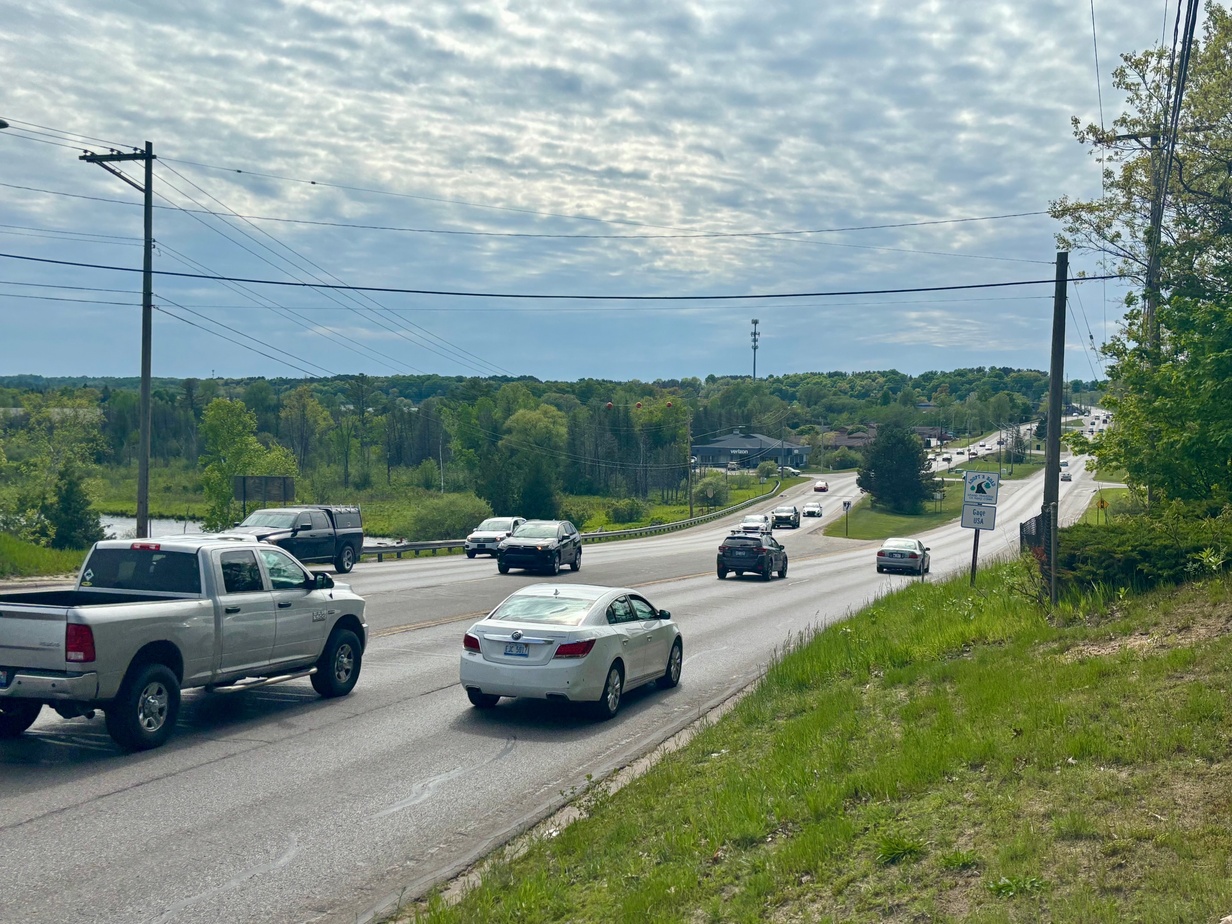
A sewer main break underneath South Airport Road Tuesday afternoon caused an estimated 21,000 gallons of raw sewage to be released and the extensive closure of westbound traffic in one of the city’s busiest corridors.
According to Grand Traverse County Public Works Director Noah Karberg, crews found and repaired a four-foot-long crack in the underground sewer main. However, the material of the pipe caught workers by surprise and is likely unsuitable for long-term use. Addressing the nearly 200-foot-long stretch where it’s in place is just the latest in a series of challenges facing South Airport Road.
Drivers Tuesday noticed sewage bubbling up through the asphalt in the westbound lanes of South Airport Road near Logan’s Landing. Multiple agencies soon responded to the scene, including the GT County Department of Public Works, GT Metro Fire, GT Road Commission, GT Sheriff's Office, and GT Emergency Management. The Road Commission closed all westbound lanes of traffic, maintaining one eastbound lane of traffic. The lane closures continued into Wednesday, snarling local traffic.
Karberg says crews expected to find a ductile iron main when they excavated the site for repairs. Instead, they found a high-density polyethylene (HDPE) pipe. The crack was along the bottom of the pipe, which is not normal for a failure, Karberg says.
“What caused that failure, I’m not sure, but I can speculate,” he says. “The pipe was compressed. Instead of round, it was beginning to take on an oval shape. It’s either old, tired pipe, or it’s a material unsuitable for this length and type of use. Or it could have been dealing with more traffic overload than it was designed for, or a combination of all those things.”
Karberg credits Team Elmer’s and a subcontractor that specializes in pipe fusion for their quick repairs, which were completed in the early hours Wednesday morning. Because that part of the sewer collection system carries 200,000 gallons of untreated sewage daily, crews early on diverted as much sewer flow as possible to other parts of the system and used a “pump-and-dump” tank collection and hauling process to move the rest. That resulted in an estimated sewage release of 21,000 gallons, less than 10,000 gallons of which entered the Boardman.
“I never want to minimize any overflow, because we always want to avoid that,” says Karberg. “But on the order of events, it’s a small event. Typically, these are reported in the millions of gallons, not thousands of gallons.” Out of an abundance of caution, the Grand Traverse County Health Department issued a Level 4 no-body-contact advisory for Boardman Lake and the Boardman River from the lake to Grandview Parkway. Environmental Health Director Brent Wheat says the department conducted sampling along the Boardman Wednesday, with results expected to be released Thursday morning. The Health Department will lift the advisory if sampling confirms “safe recreational conditions,” he says.
Following the sewer repairs, the Road Commission worked to patch up South Airport Road – and to evaluate its underlying stability. Road Commission Manager Dan Watkins said in a Facebook video that as sewage was bubbling up, it also brought up sand, gravel, and sediment from underneath the road.
“There’s potential voids under here, so if we open this back up to traffic, we don’t want to have any collapses,” he said. “The other concern is how saturated is the gravel down here. Essentially this could potentially be like Jell-O.” While evaluations remained ongoing, the Road Commission was able to open both eastbound lanes of traffic and one westbound lane of traffic Wednesday afternoon.
The incident raises bigger issues about the long-term future of South Airport Road. Road commissioners were already scheduled to vote tonight (Thursday) to approve a contract to armor the culverts on South Airport Road near Logan’s Landing. That’s in response to the April floods that almost took out the culverts, as they did the Beitner Road culverts. Road Commissioner Joe Underwood explains the armoring will help harden the culverts against the river flow. “That should buy us enough years to get the other fix done,” he says.
The “other fix” is reconstructing South Airport Road at its Boardman River crossing, potentially raising the crossing out of the floodplain, accommodating higher river flow, and creating a safe crossing underneath for pedestrians. A steering committee of community leaders has begun a year-long process to evaluate and recommend design options. Garfield Township and Grand Traverse County officials recently approved letters of support asking the Grand Traverse Band of Ottawa and Chippewa Indians to participate in the advisory group and to seek federal grant funding for the design project.
In addition to South Airport Road itself, the underlying infrastructure must also be addressed. Karberg says the HDPE pipe stretches at least 179 feet and will need a long-term solution. That could include an option like pipe bursting, a trenchless repair that pulls a specialized bursting head through the old pipe, which then expands and splits and makes room for new pipe to be installed in its place. That’s the approach Garfield Township will soon take to replace a compromised section of sewer main further up South Airport Road near the Cass Road intersection. Another option is for new sewer infrastructure to be installed at the same time South Airport Road is reconstructed, Karberg says.
As often occurs with sewer breaks or overflows, Tuesday’s incident sparked a flurry of online comments complaining that Traverse City’s system is overtaxed or at capacity because of tourism or overdevelopment. Karberg recognizes the argument but believes it’s “only relevant to specific sections of the infrastructure.”
“I wouldn’t characterize this break as a development break,” he says. “It’s an age-of-infrastructure break.” Part of the issue is that materials used 50 years ago – when many pipes were built – often aren’t adequate for modern use, he says. The HDPE is “non-standard material,” so it’s difficult to say whether it would have failed either way or had experienced accelerated decline from increased road or use pressure, Karberg says. While he sees more pressure on the water side of the system than the sewer side from population growth, Grand Traverse County is still evaluating its sewer system to prioritize repairs – a reality facing many municipalities struggling to keep up with aging infrastructure.
“The rule of thumb is that a utility can expect 20 breaks for every 100 miles of main,” Karberg previously said. “We’re on pace to exceed that, so we need to look at how we can do more preventative and proactive inspections and replacement.”
Comment

Applications Now Open for Expanded Michigan Reconnect Program
Read More >>What’s Next for South Airport Road?
Read More >>TVC Travel Stays On Record Pace
Read More >>Garfield Township Issues Moratorium on Data Centers
Read More >>



Grand Traverse County Land Bank Authority Begins Kingsley Demolition
Read More >>No Body Contact Advisory Issued for Boardman River/Lake
Read More >>South Airport Road Closed Near Logan's Landing, Likely Sewer Break
Read More >>Driver Charged with OWI Causing Death in Peninsula Township Crash
Read More >>NMC International Affairs Forum Announces 33rd Season
Read More >>New Test Range Designation For Camp Grayling Could Turn Traverse City Into A Drone Tech Epicenter
Read More >>