DDA Board Approves Design for $5.7M Riverfront Project
By Beth Milligan | Jan. 17, 2026
The Traverse City Downtown Development Authority (DDA) board Friday approved the schematic design for a proposed $5.7 million reconstruction of the Lower Boardman/Ottaway riverwalk area, a project that would include a remodeled J. Smith Walkway, new pedestrian amenities in the adjacent alley and parking lot, and a new pedestrian bridge to connect the alley to the farmers market lot. The DDA now has designs for all three of its last major TIF 97 projects – including Rotary Square and a new farmers market pavilion – and will soon make budget decisions on construction.
DDA Executive Director Harry Burkholder said riverwalk improvements have been in the works since at least 2018, when the DDA started working on its Lower Boardman River Unified Plan. The plan outlines desired improvements for the entire 1.6-mile urban section of the river downtown, including both ecological and placemaking upgrades. Based on public feedback, consultants INFORM Studio helped the DDA create a conceptual design in 2022 for redesigning the entire riverfront between Union and Park streets. Estimated at $63.5 million, the plan was envisioned to be tackled in up to nine phases over a likely multi-decade timeline.
With the DDA’s TIF 97 plan to set to expire at the end of 2027, board members recently prioritized three major projects to tackle with remaining funds. Completing a first phase of riverwalk improvements – called Phase 1-A – was one of those. Board members approved a contract with INFORM Studio in February for a not-to-exceed cost of $486,419.50 for schematic design and design development services. The project area included the J. Smith Walkway, a replacement for the existing bridge over the river between the J. Smith Walkway and farmers’ market lot, and pedestrian amenities in the surrounding alley and parking lot.
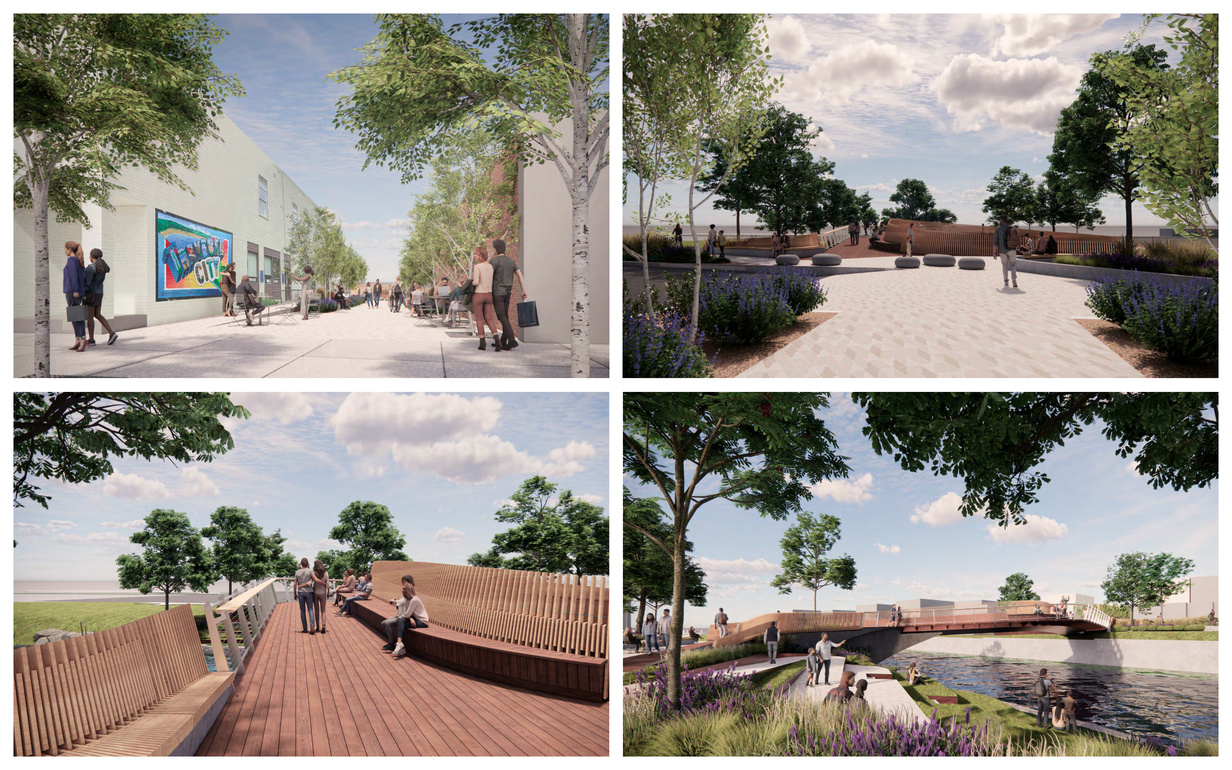
On Friday, INFORM Studio Principal Michael Guthrie led DDA board members through a detailed overview of the design. Guthrie said the goal was to create a cohesive pedestrian flow from Front Street all the way to Lot B, the farmers market lot – using the same materials to create a contiguous visual look. The J. Smith Walkway would still have seating areas, benches, and tables, but would have a wider clear path through the middle – no more fountain – to make it easier for pedestrians to pass through. Trees would line either side to create a “canopy” effect, with a more “urban” feel to the walkway closer to Front Street that gradually transitions to a more natural feel approaching the river, Guthrie said. Elements people enjoy now, such as the Traverse City mural where visitors often take photos, could be preserved and better showcased in the new design, Guthrie said.
At the end of the walkway, “seating pebbles” could serve as natural bollards to block cars. A plaza area in the alley would help beautify the corridor and transition pedestrians to the bridge. The plaza would serve as a visual warning to drivers, who would cross a speed table as they near the area to slow their approach. The plaza would eliminate 12 alley parking spaces; the design also proposes to eliminate two spaces on Front Street to provide a clear visual approach to the J. Smith Walkway entrance.
A new curved bridge is proposed to replace the existing pedestrian bridge connecting the alley to the farmers market lot. The curved design creates a natural overlook area and accommodates river clearance and runway necessary for universal accessibility, Guthrie said. Board Chair Ed Slosky previously noted that the existing pedestrian bridge over the river is “falling apart.” Though still deemed safe for pedestrian use by city engineering, it only has an estimated 10-year lifespan left, Slosky previously said. The new bridge would connect to a northern pedestrian plaza with a terrace down to the water, seating areas, trees, and native riparian plants.
The project includes low surface lighting throughout – which can be dimmed or brightened or feature different colors – to create a welcoming environment, Guthrie said. He described the design as “something that will not necessarily compromise the performative aspect of how the alley has to work for the businesses that are there, but at the same time creates a better sense of place and appreciation for the natural elements of the riverfront.” Mayor Amy Shamroe said the project could be “transformative” in highlighting the Boardman/Ottaway downtown, calling it a “once-in-a-lifetime opportunity to transform a space that has been neglected for generations.”
DDA board members extensively discussed environmental and stormwater improvements in the area. While the pavers proposed for the J. Smith Walkway will allow filtration and have soil cells underneath to support water capture and tree health, board member Mike Powers felt the project didn’t go far enough in addressing stormwater improvements. He was the sole ‘no’ vote against the design. Guthrie said the design was significantly more “sustainable” than the existing infrastructure and noted that stormwater controls are part of a larger system outside the area that could be addressed in future phases.
The project is estimated at $5.7 million total, including $5.5 million in construction. Several other projects could tie into or impact the riverfront improvements, Burkholder noted. The DDA was recently awarded $657,750 in federal funding for downtown river work, including in-stream habitat improvements. The Phase 1-A project area is targeted for one of those habitat restoration projects. The city must also decide what to do with the retaining wall along the river in the 100 block alley. Guthrie said the new bridge design can function independently of the wall. City commissioners will vote Tuesday on a proposed $171,527 contract with Wade Trim to study and make recommendations on the wall.
The redesigned riverfront will also tie into the design for a new farmers market pavilion, Burkholder said. DDA board members recently approved the design for that pavilion, which will soon be reviewed with the planning, parks and recreation, and city commissions and then go to bid for targeted spring construction. That project is estimated at $2.5 million. The third and final major project planned for TIF 97 funds, Rotary Square, is estimated at $2.55 million, bringing the three projects to an estimated $10.75 million.
The DDA at one point estimated it had about $9 million remaining in TIF 97 funds. Burkholder tells The Ticker that figure needs to be updated with the city treasurer’s office to ensure it’s still accurate. Grant and other funding sources could help complete the three projects. However, Burkholder says the DDA board will need to make decisions about construction and timing to determine whether it’s feasible to complete all three projects under TIF 97. It’s possible one project could be held back and included as the lead project for a new TIF plan – called Moving Downtown Forward – which the DDA intends to put before voters this fall, Burkholder says.
Either way, DDA officials expressed excitement about having designs for three major projects discussed for years. “I know that's been a frustration of the public: It feels like all talk, no action, for years, but all that talk is giving us these amazing projects, and I'm so excited to see what's rendered here,” said Shamroe. Burkholder agreed. “We’ve made a tremendous amount of progress…we're at the precipice of actually making these things come to fruition,” he said.
Photo credit: INFORM Studio
Comment

Interlochen's Latest World Premiere Theatre Production Has Deep Roots
Read More >>Traverse City State Theatre Announces Reopening Plans
Read More >>TCPD Investigating Student Accused of Creating Compromising AI Images of Others
Read More >>New Concept, Same Owners: Mama Lu’s to Become Asian Restaurant Happy Cat
Read More >>



City Eyes Parking Rate Increases, Changes to Rotary Square Alley
Read More >>Your 2026 Road Construction Guide: US-31, Bridges, Franke, Hammond, Cass & More
Read More >>Eleven St. Patrick's Day Events in Northern Michigan
Read More >>TCAPS Trustees to Vote on $17.2 Million Fieldhouse Project
Read More >>Concerns Mount Over Jail Conditions; Facilities Study Moves Forward
Read More >>Groundwork Center Announces New CEO
Read More >>