
The Conservancy's Secret Weapon Against Invasive Species
By Ross Boissoneau | Feb. 22, 2026
Some of the most industrious workers in the area are taking the winter off. But don’t worry, come spring, they’ll be hard at it again.
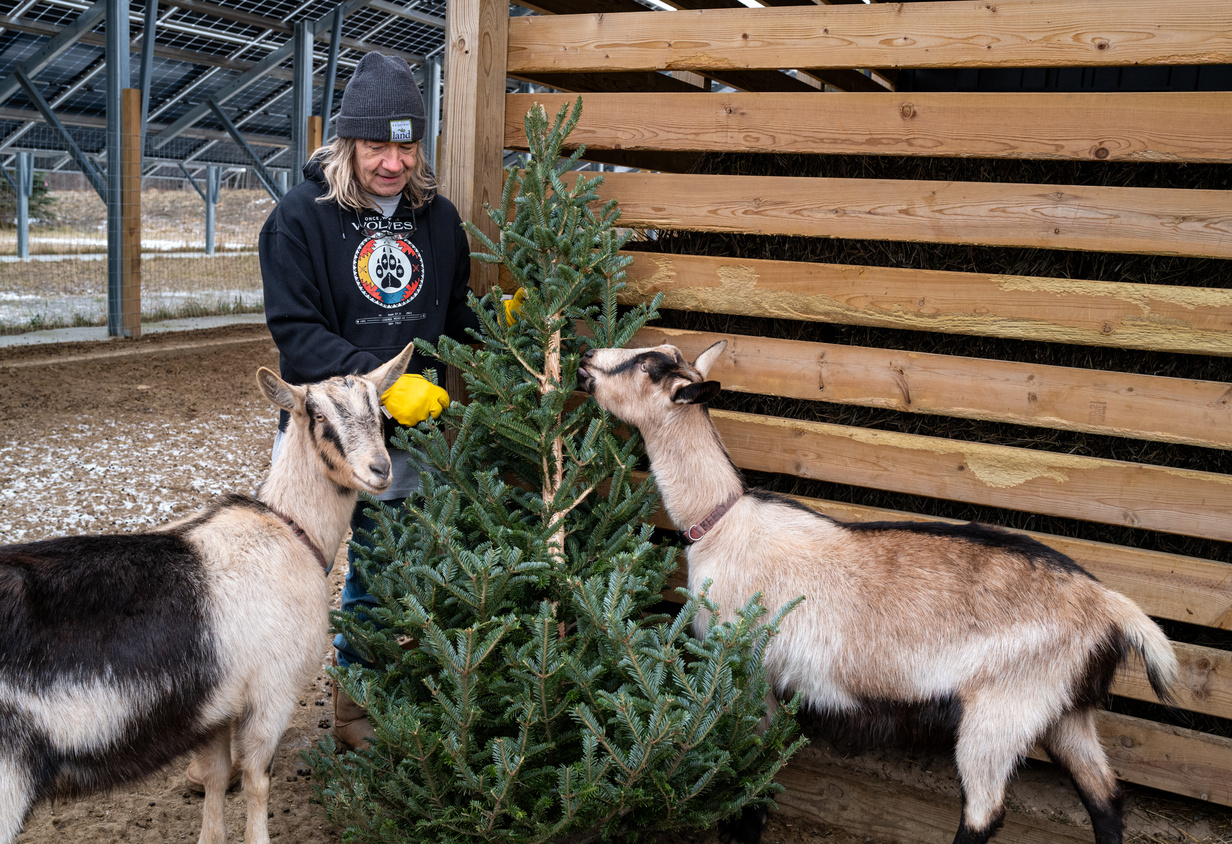
The Grand Traverse Regional Land Conservancy’s two herds of goats are among the best tools the Conservancy has to combat invasive species. They happily feast on the various plants that threaten native flora. Until then, they will dine on some of their seasonal favorites – pumpkins in the fall, and Christmas trees in the winter.
Sam Griffin is the farm operations & sustainability coordinator for the Conservancy, a.k.a. the goat wrangler. “I’m part of the stewardship team. We care for the land,” she says. “The goat herd is part of the restoration.”
Among the goats’ favorite foods is autumn olive, a shrub native to Asia that was introduced in 1830 as an ornamental plant that could provide habitat and food to wildlife and widely planted by the Soil Conservation Service as erosion control near roads and on ridges. It outcompetes and displaces native plants with its rapid and uncontrollable spread.
“Autumn olive is the big one,” says Griffin. “It’s very vigorous, with thick dense patches with thorn. It’s hard to get to. Goats do a good job of knocking it back."
Another is honeysuckle, which creates dense thickets of plants and outcompetes native plants. Its attractive red/orange berries offer poor nutrition for birds. Garlic mustard crowds out native plants like spring beauty, trillium, and pink lady slippers, which in turn reduces the food supply for birds, butterflies, and other wildlife. The goats will eat the plants down to the ground.
The Conservancy first enlisted the aid of goats in 2017. They acquired a second herd in 2023. Both now have permanent homes, one based at Misty Acres Farm at Misty Acres: The Borwell Preserve in Benzie County, the other at the Conservancy’s headquarters at Mitchell Creek Meadows: The Don and Jerry Oleson Nature Preserve.
Goats are a natural, low-impact approach to managing invasive species. The goats graze on the various aggressive invasive plants, which are scattered throughout the Conservancy headquarters and the Borwell Preserve. And as with many of the Conservancy’s properties, they include sensitive wetland areas that aren’t suitable for vehicles or heavy equipment.
Enter the goats. They can reach areas heavy equipment can’t, and their carbon footprint is significantly lower. “Their job is to go out and eat. I like to think they’re enjoying their job,” Griffin says.
They are not just among the most effective means of controlling invasive species. They’re also really cute. Just ask Jeanne Wolfe and Deb Jackson, two of the many volunteers who assist Conservancy staff in managing the goats. Wolfe works with the the herd at the Conservancy’s Three Mile Road property, while Jackson volunteers with the herd in Benzie.
“I met the goats and realized my compassion and energy aligned with the goats,” says Wolfe. “We bonded.”
“We pet them, we love them. They keep me out of the house,” says Jackson. She and her husband are both retired and work two days a week with the goats.
And make no mistake, it is work. It’s not all lollipops and garlic mustard. In the temperate season, they move the goats around from place to place on the property, keeping them from going too far afield by using mobile fencing. The volunteers are the ones who haul and install the fencing. They also feed them and take them water, grain, and baking soda, which helps prevent bloat.
In the offseason, the goats are housed in barns on the property. Whatever the season, volunteers are needed to help feed and groom the goats, watch them for any sign of illness or other problems, and socialize with them. Goats are among the most social and sociable animals, both with other goats and with their human caretakers.
“Goats are one of the earliest animals to be domesticated. To me they represent resilience and perseverance,” says Wolfe.
When they aren’t working, the goats stay comfortable and safe in indoor and outdoor spaces at the preserve. A sheltered barn on the property features a large wintering area and a heated medical bay where they can be treated for illness (including wi-fi access for their caretakers), with a hay storage area conveniently located nearby.
Griffin says that initially they moved the herds among the various Conservancy properties. While all the properties benefited, herding and transporting them was a hassle at best. With plenty of invasive snacks at the site in Benzie, plus a barn for housing them, and then the same circumstances at the headquarters on Three Mile, they made the decision to house them permanently at those two locations. They still move around the 600 acres of the Borwell Preserve and 243 acres of the Mitchell Creek Meadows. Plenty of room for goats, and plenty of invasive foraging.
Comment

TCAPS Announces Five National Merit Semifinalists
Read More >>Warehouse MRKT Sold; What’s Next for Tenants?
Read More >>TC State Park to Reopen for Fall Camping
Read More >>Housing, Trail/Mobility Initiatives on City Agenda
Read More >>



The 2026 Vineyard Recap
Read More >>'Skills of Our Shared Humanity:' Kingsley Folk School Preserves Traditions, Builds Community
Read More >>Up North Pride Week Returns September 22-26
Read More >>TVC Offers City Million Dollar Tree Deal
Read More >>Military F-16 Fighter Jet Crashes Near Grawn
Read More >>Summer Report Card 2026: Traverse City's Peak Season Was a Celebratory, Smoky, Gridlocked Mixed Bag
Read More >>