Behind The Wheel: Why TCAPS Bus Drivers Love The Ride
By Ross Boissoneau | May 16, 2026
As the school year nears its end, most students are counting down the days until summer. But before the last bell, thousands of students rely on a familiar face behind the wheel.
Traverse City Public Schools (TCAPS) bus drivers navigate dark winter mornings, busy neighborhood stops, and buses that weigh up to 30,000 pounds. Not everyone is cut out for it.
But for a certain group of TCAPS drivers, the job is more than a route.
Meet Pete LaCourse. “They’re great kids,” he says of the students on his route. A longtime coach and physical education instructor at both primary and secondary levels as well as college, he noticed the need for bus drivers at TCAPS and decided to give it a try. “I loved working with kids. Two years ago they needed bus drivers desperately. It’s a decent wage, health insurance. I got my CDL and fell in love with it.”
LaCourse says the early hours – he arises at 4am every weekday – don’t faze him. “I like the school schedule. It’s five days, early morning and afternoon. You have weekends and evenings off, spring break, Christmas break. I have three boys in high school and get to spend time with them.”
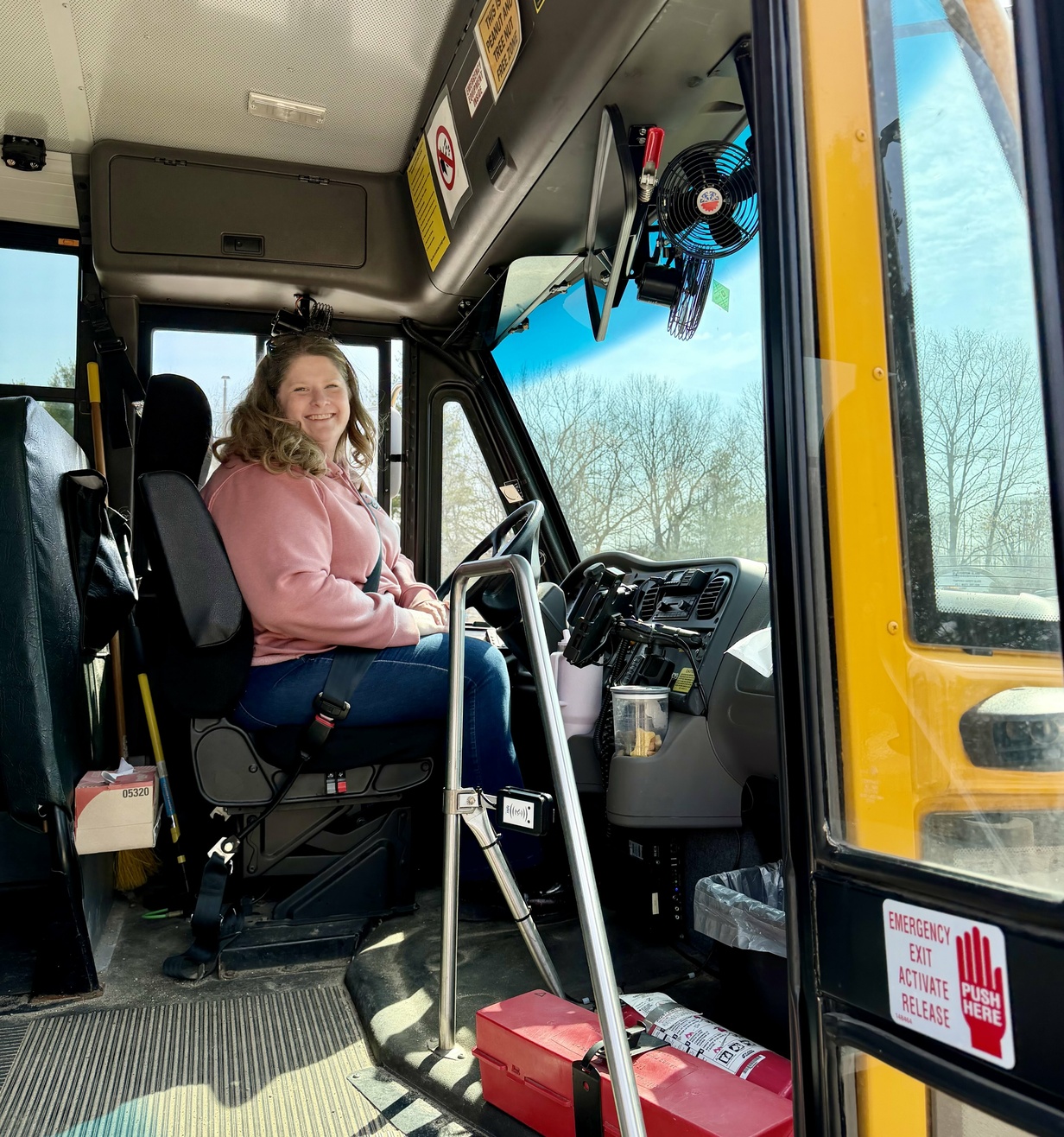
Jessie Schaub (pictured) says it suits her as well. “I was in banking and I needed a change. I found I really enjoyed it,” she says.
So much so she’s been driving for TCAPS for a decade and is now training new drivers. Despite the early mornings. “I get up at 4:45, work 6 a.m. to 9:30, then 2 to 5:30,” she says. That gives her time to do errands, make appointments – or sometimes catch up on her sleep. “Sometimes a nap is needed,” she admits with a laugh.
She says driving elementary students is especially rewarding. “We share things. We’re affirming, talk about being kind to others and yourself. I enjoy that small way to personally interact,” Schaub says.
Those who have retired also remember the good times. Mike Hunter became a TCAPS bus driver after completing his long-delayed degree from Central Michigan University. He had left music school to work in the restaurant industry, and after earning his degree was teaching music at Northwestern Michigan College and giving private lessons as well as performing. He wanted something more and the bus schedule allowed him to work his other jobs.
They say that though they drive separately, there is camaraderie among the group. Hunter recalls one driver who sang in her church choir who knew he directed the vocal jazz ensemble at NMC. She asked if he would start a singing group among the drivers. “The head of the department was a piano player, so we put a group together. We sang at some churches,” he says.
Seamus Shinners was a bus driver for nearly 30 years, and served as the head of the Bus Drivers Association for more than a decade. He says many during his time were retirees who had had successful careers in other fields. Others were working part-time at other jobs, which made what he thought was a unique mix.
Despite their differing backgrounds, the group always worked well together. “It was a cross section, all walks of life,” he says. “It was a second job or a primary job.”
There were, of course, the inevitable disruptions. He recalls one ninth-grader who he made move to the front seat so Shinners could keep an eye on him. When asked what he could do to return to his familiar seat with his friends, Shinners told him he had to pass a quiz, and asked him to recall the rules for good bus behavior displayed on each bus – without peeking.
He was able to remember some, but not all. The next day, he eagerly asked Shinners if he could take the quiz again. Shinners agreed, then said, “Name the seven dwarves.” The student was dumfounded and could only name a couple. Eventually he was able to make his way back to his preferred seat, but Shinners says that was a way to keep discipline using humor.
They all recall the good times more than the occasional disciplinary problem. “Sometimes the kids make you laugh like hell,” says Hunter.
“The best experience is when I see the kids out somewhere,” says LaCourse. One youngster approached him at a sporting event and said, “Thank you for driving me to school in the morning."
“He came up and thanked me. It was heartwarming,” LaCourse says.
He also does some of the driving to and from athletic events and occasionally encounters some of the same kids he coached in elementary school. “This year at Central I had coached ten of the 12 (on the team). They said, ‘Hey Coach Pete!’”
Those memories echo for the students and their parents. Shinners has been approached by parents who valued his dependability. “You drove my daughter to school,” he recalls being told. “We could always count on you. When you said you’d be there at 7:05, you’d be there.”
Not that it’s always easy. On those dark, dreary winter mornings, battling snow and slippery roads is a challenge. “Getting up early, bad weather, bad traffic. It’s scary sometimes,” Schaub admits.
“I always wanted it (the day) to be boring, the same. Get back, park the bus with no damage and go home,” says Hunter.
Get On The Bus
· Width – 8 feet
· Length – 40 feet
· Height – 10.5 feet
· Weight – 27,200 to 30,000 pounds when empty
· The TCAPS fleet includes 78 buses and employs 63 bus drivers
· Most TCAPS buses are rated at 77 passengers
· Bus service is provided to approximately 35percent of TCAPS students as well as local private and parochial school students
· Total routes include more than 2,000 bus stops in a 300-square-mile area
· Drivers travel more than 6,000 miles per day; the district averages over a million miles annually.

Date Set For TC Central Track Dedication
Read More >>Opioid Spending Tops County Agenda
Read More >>TCBN: Private Equity Making Noise in Northern Michigan
Read More >>City Ready to Adopt New Parks Plan
Read More >>



What To Know About This Year's Cherry Festival Air Show
Read More >>Valarie Handy Named New Deputy City Manager
Read More >>Road Projects on Deck: Work to Start Soon on Franke, East Silver Lake, Skegemog Point
Read More >>Dennos Museum Center Gets a New Look and New Exhibits
Read More >>Hilton Tapestry Coming to Front Street; More Downtown News
Read More >>Allegiant Cuts TVC Fort Lauderdale Flights
Read More >>