
City Plans for Future of Sewer Plant: Odor Control, Capacity
By Beth Milligan | March 24, 2026
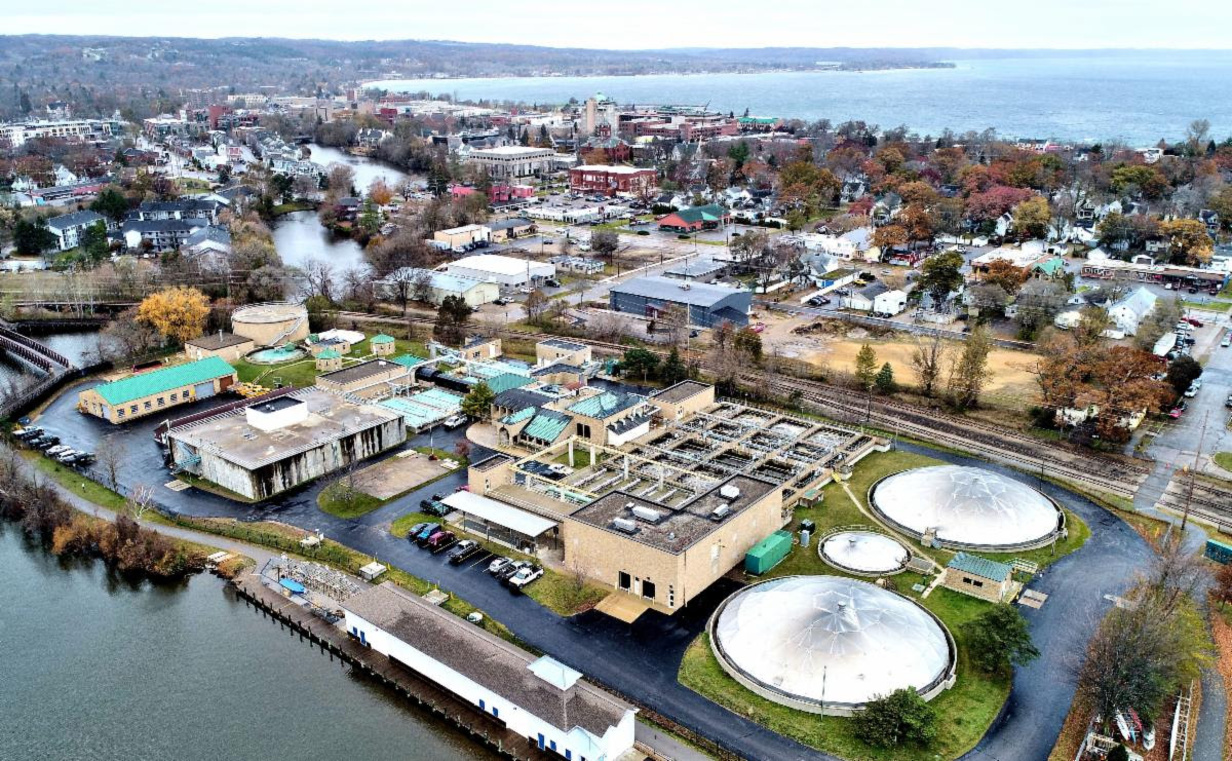
In addition to a multi-year, $35.5 million investment to modernize the city wastewater treatment plant – plus plans to replace eight membrane trains over the next decade – Traverse City commissioners are eyeing two major studies to address the top recurring concerns about the plant: its odor control systems and its capacity.
Commissioners recently heard about both issues from Jacobs, the firm that operates the plant on Boardman Lake. The plant not only serves the city but six surrounding townships. While plants in other communities that are located outside of town – where odor issues “may not be an issue,” said Steve Graziano of Jacobs – Traverse City’s plant location near downtown means odors can affect “where people live, work, and play,” he said.
City Manager Benjamin Marentette acknowledged in a memo that the city has dealt with recurring complaints about a “significant odor smell near the wastewater treatment plant, specifically a ‘rotten egg-type smell.’” Commissioner Ken Funk said the odor is “something a lot of people in the community have talked about for a long time.” Graziano said that while there are a “wide ranges of odors at a wastewater treatment plant,” the majority are associated with sulfides that develop into hydrogen sulfide gas. Humans can detect that odor in “very low concentrations,” he said. Not only does that impact quality of life, it can pose a risk to worker and public safety at higher concentrations and corrode equipment over time, he said.
Commissioners are expected to vote in April on approving a study that will analyze the plant’s existing odor treatment systems, identify and prioritize odor sources, and estimate odor emission rates. The study will also evaluate off-site impacts through air dispersion modeling. Jacobs will present recommendations for mitigation technology, including “cost-effective solutions” that can be built into the city’s capital improvement plan. Community engagement will be part of the process to better understand local impacts and share study results with residents. The study is estimated to cost $80,000 and take about six months to complete, according to Jacobs.
Commissioner Heather Shaw pointed out that growth is continuing around Boardman Lake and the Eighth Street corridor, which means odors from the plant are affecting a rising number of people. If the city hopes to encourage density in the area, “odor mitigation is very much what could be called economic infrastructure,” she said. Graziano said it was unlikely the city could ever get to “zero odor,” as that’s difficult to do with wastewater treatment plants – but could significantly reduce impacts past the plant’s fence line with the right combination of technologies.
City Director of Municipal Utilities Art Krueger warned commissioners that in the meantime, odors might be particularly noticeable through early April because of improvements happening at the plant. As part of a project to upgrade the plant’s headworks and UV disinfection system, workers have to move the odor control infrastructure – meaning it will be shut down for a period, Krueger said. That work has already begun and is expected to wrap up by April 10. “It’s the march towards progress, so we appreciate that (work),” said Mayor Amy Shamroe.
Jacobs also presented an update to commissioners on the plant’s capacity. Capacity is primarily measured in two ways: the maximum monthly flow, which measures the plant’s ability to treat a set liquid volume daily, and its peak hour flow (hydraulic) capacity. The latter refers to the plant’s ability to manage flow during peak hours without backups or overflows, according to Jacobs. The city’s plant has a maximum monthly flow of 8.5 million gallons per day (MGD) and peak hourly flow of 17 MGD.
While the state doesn’t have a number “set in stone you have to reach before you upgrade (your plant),” it offers guidelines, said Mark Huggard of Jacobs. When a plant reaches 80 percent of its capacity, it’s recommended that a community start planning for expansion. When it reaches 90 percent, it should start the permitting process. In 2025, the city was at about 62 percent during peak usage in July, Huggard said.
Over the last decade, the plant’s usage has remained “consistently” below the 80 percent capacity level. “There’s no sustained upward trend,” Huggard said. However, the plant briefly spiked over 80 percent in 2015 and 2020 – both years that had high lake levels and heavy rain events, with water infiltrating pipes and causing heavier flows to the plant. Huggard said the fact those years were one-offs and not maintaining a steady trend means there’s not a concern about capacity issues.
However, staff are monitoring another trend at the plant. That’s the organic loading capacity, or the amount of organic material present in the wastewater coming into the plant. That figure is steadily trending upward and was at 60 percent last year. The main issue then facing the plant is the “strength of wastewater” coming in rather than the volume, Huggard explained.
There could be multiple reasons for that, staff said. Ironically, one factor could be the city’s own improvements to its system. The city has been working to reline many of its pipes, including lining 9,000 feet over the past year. Those efforts have meant less inflow and infiltration (outside water getting into the pipes) is occurring. However, that also means that the organic material present in the pipes could become more concentrated without excess water to dilute it. Population growth could also be contributing to the rise, Jacobs representatives said. Organic loading is important because it can affect everything from how equipment operates to the production of sludge to odor and nuisance issues.
Krueger said the benefits of improving pipe lining outweigh the drawbacks. And there are no “ongoing flow-related capacity issues” at the plant from either city or township usage, Jacobs said. Still, because of the potential for organic loading to affect treatment efficiency in the future, the city plans to do a full capacity study for the plant. That study is already included in next year’s capital improvement plan, Krueger said, meaning commissioners could potentially approve it as part of next year’s budget.
Photo credit: City of Traverse City
Comment

Seventh Street Closures Start Today
Read More >>City Braces for Historic Retirement Wave
Read More >>Local Kitten Rescue Calls for More Responsible Pet Owners
Read More >>Jet Has Landing Gear Alert at TVC
Read More >>



Shooting For The Moon, TC Artist Lands At ArtPrize
Read More >>Copy That: Local Print Shop For Sale
Read More >>Local Athlete Makes National Wheelchair Curling Team
Read More >>Northwest Michigan Housing Summit Set for Oct. 26–27
Read More >>International Fireworks Championship Returns
Read More >>Downtown Halloween Walk Moving to Weekday
Read More >>